
Birds Between Nature and Culture
An ethno-ornithological tour across the Oxford University Natural History Museum and the Pitt Rivers Museum.











Welcome!
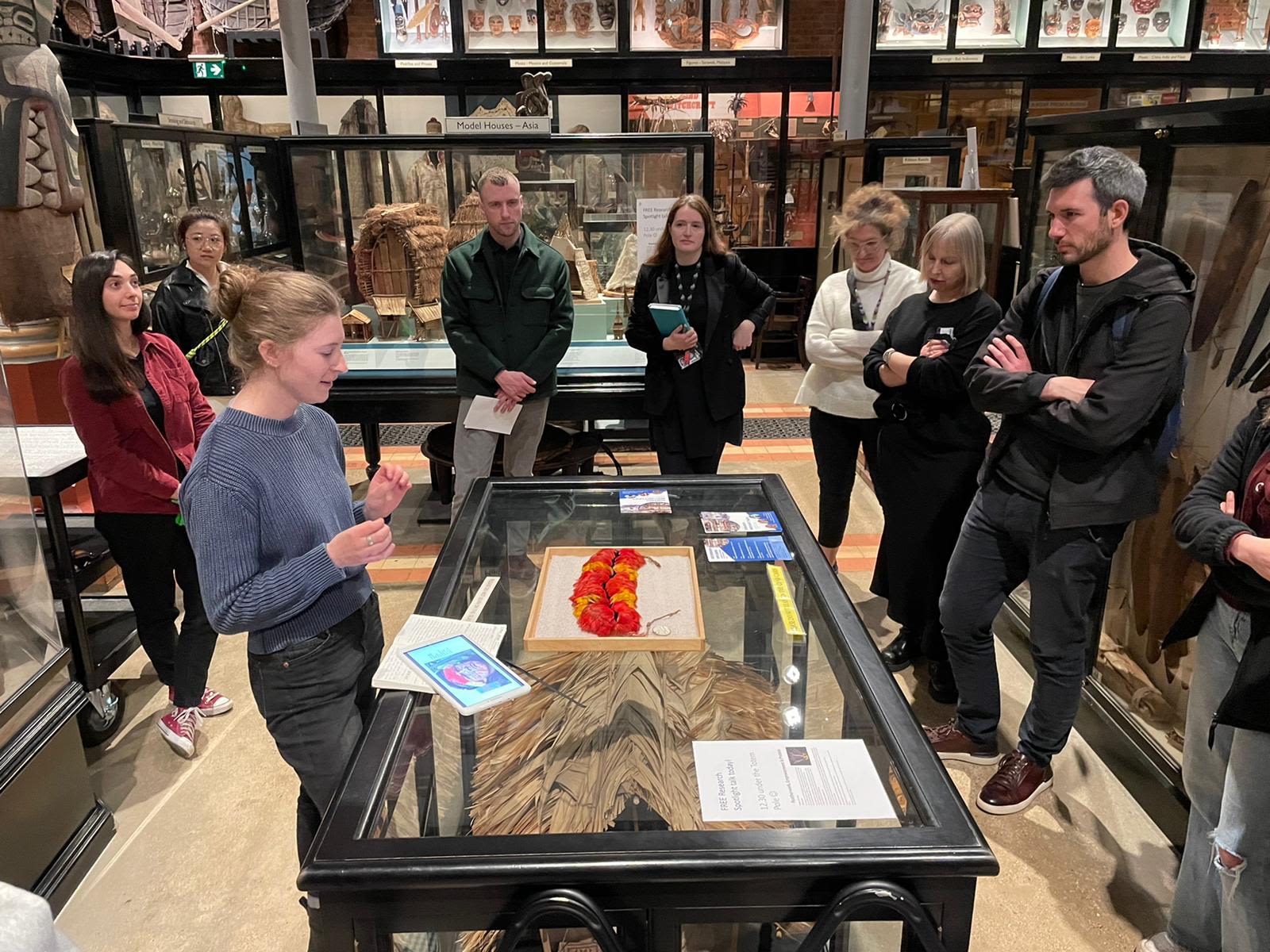
I’m Rosa and I’m currently a PhD student working with the Pitt Rivers Museum. My research focuses on exploring relationships between people and birds through museum objects.
We’re going to start here in the Oxford University Natural History Museum, and meet a few of my favourite birds represented in the form of taxidermies and dioramas. We’ll then walk next door to the Pitt Rivers Museum and meet these birds again, but this time as their bodies and feathers are incorporated into ethnographic objects. As we move between these two spaces, we are going to explore how birds can be represented both by Western science, but also within Indigenous worlds. I hope by the end you’ll have been able to learn some new things about these beautiful birds, but also have been able to explore some of the diverse ways in which people and birds relate to each other and their environments.
Birds in museums
Natural history museums allow us to encounter some of the wondrous biodiversity we have on Earth together in one space. We can view close-up animals which we would have to travel the world to see alive in their native habitats. Some of the tropical birds in this case are one’s which in life probably inhabited the canopies of the Amazon rainforest thousands of miles away. At some point, they have died (or been killed), been collected, transported and then skinned and formed into the taxidermies which are now posed together in the case.
The word “taxidermy” comes from the Greek: taxis, meaning arrangement or movement, and dermis, meaning skin. Taxidermy is about arranging the skin of a dead animal to create a lifelike form. The birds we can see in this museum are intended to be representatives of their species, upholding their position within the expansive tree of Linnaean taxonomic classification. Behind glass, they can no longer fly away and we don’t have to travel to the Amazon rainforest to hope for a fleeting glimpse from the canopy. Here, the birds are captured, preserved, and made permanently visible to us.
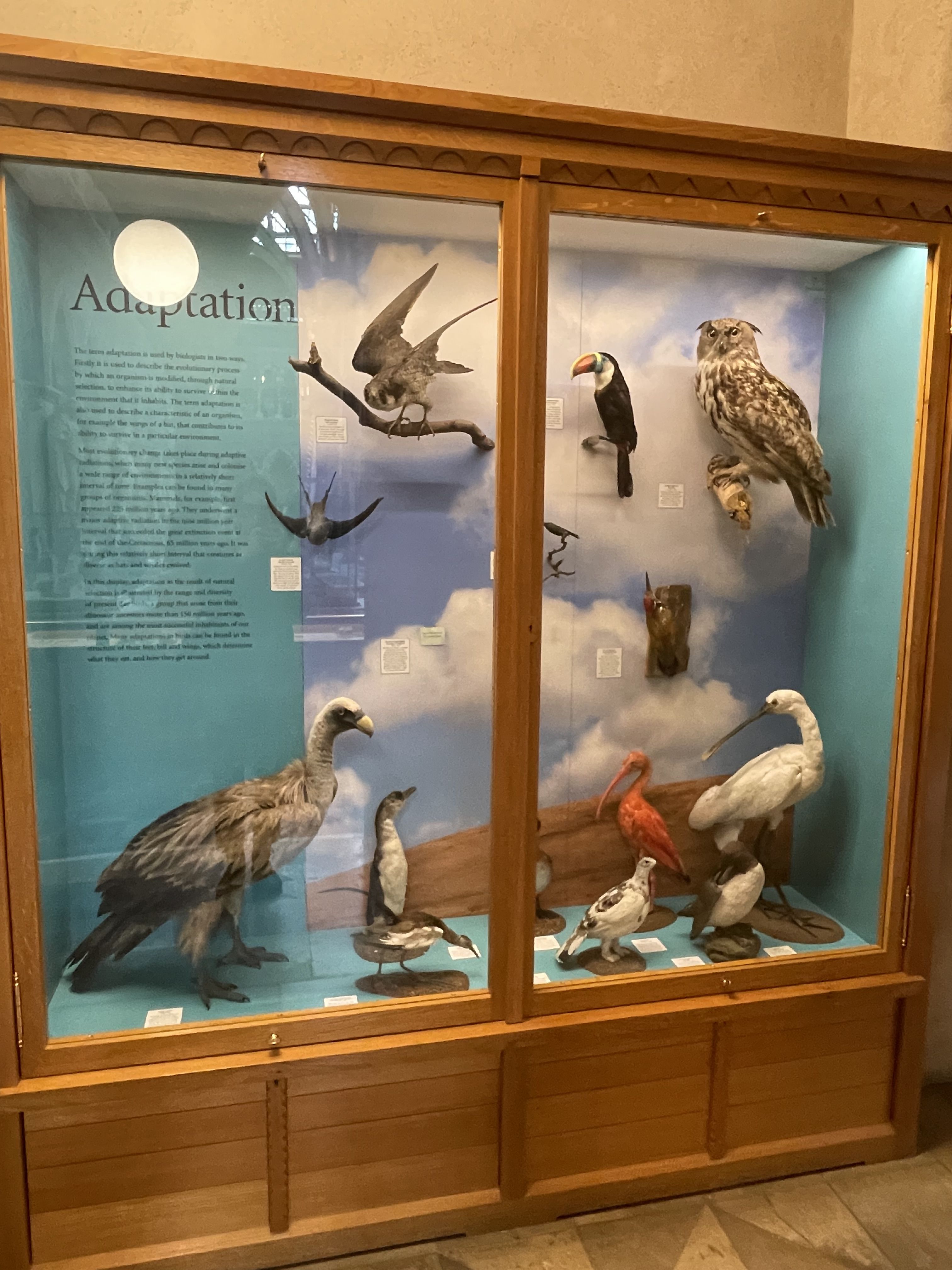
Some displays like this one place a range of specimens together to teach us about certain ecological concepts, in this case, the idea of Adaptation. The birds here have been selected to show a range of different morphological characteristics.
Lets explore one of these specimens in detail:
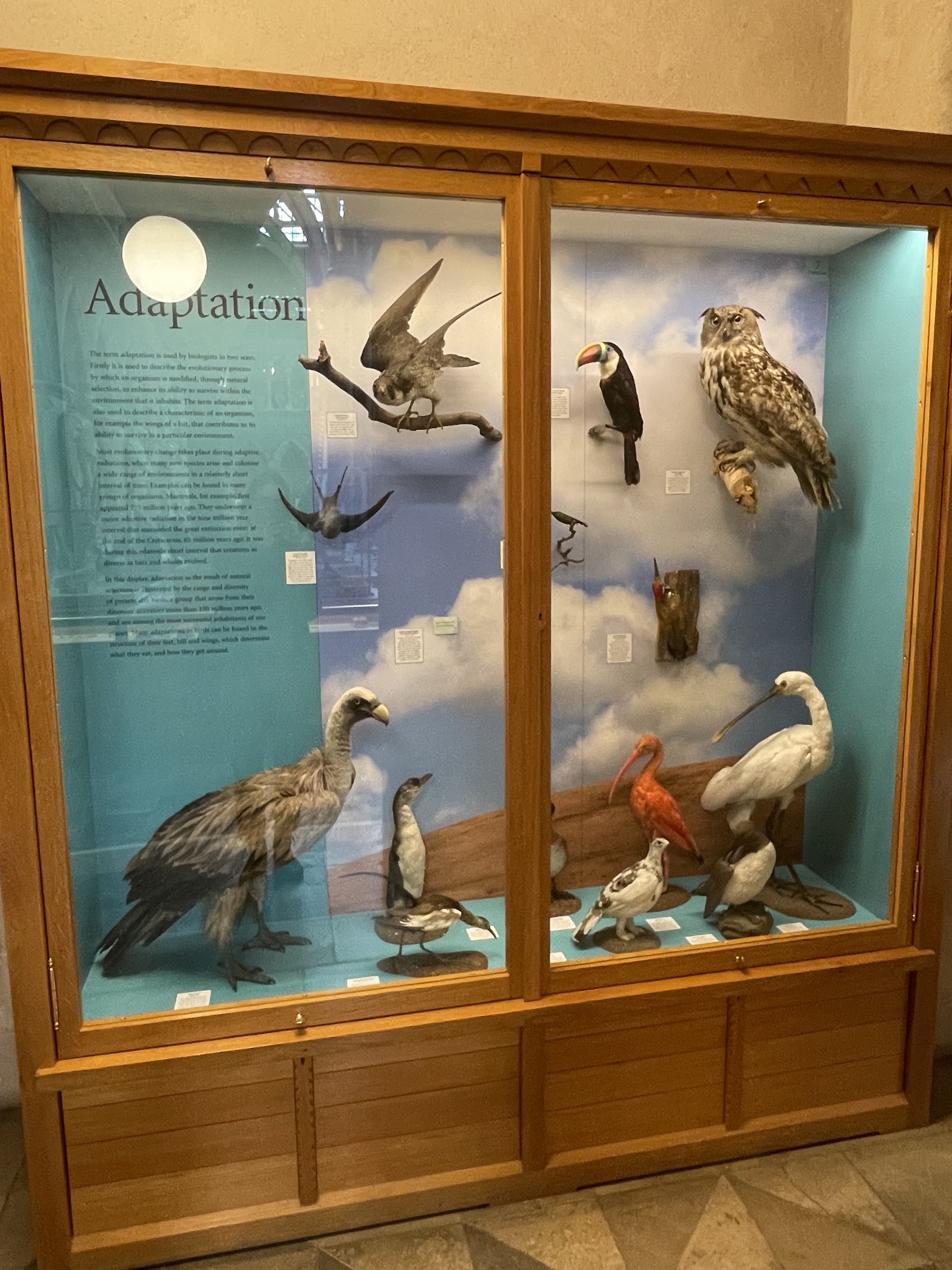
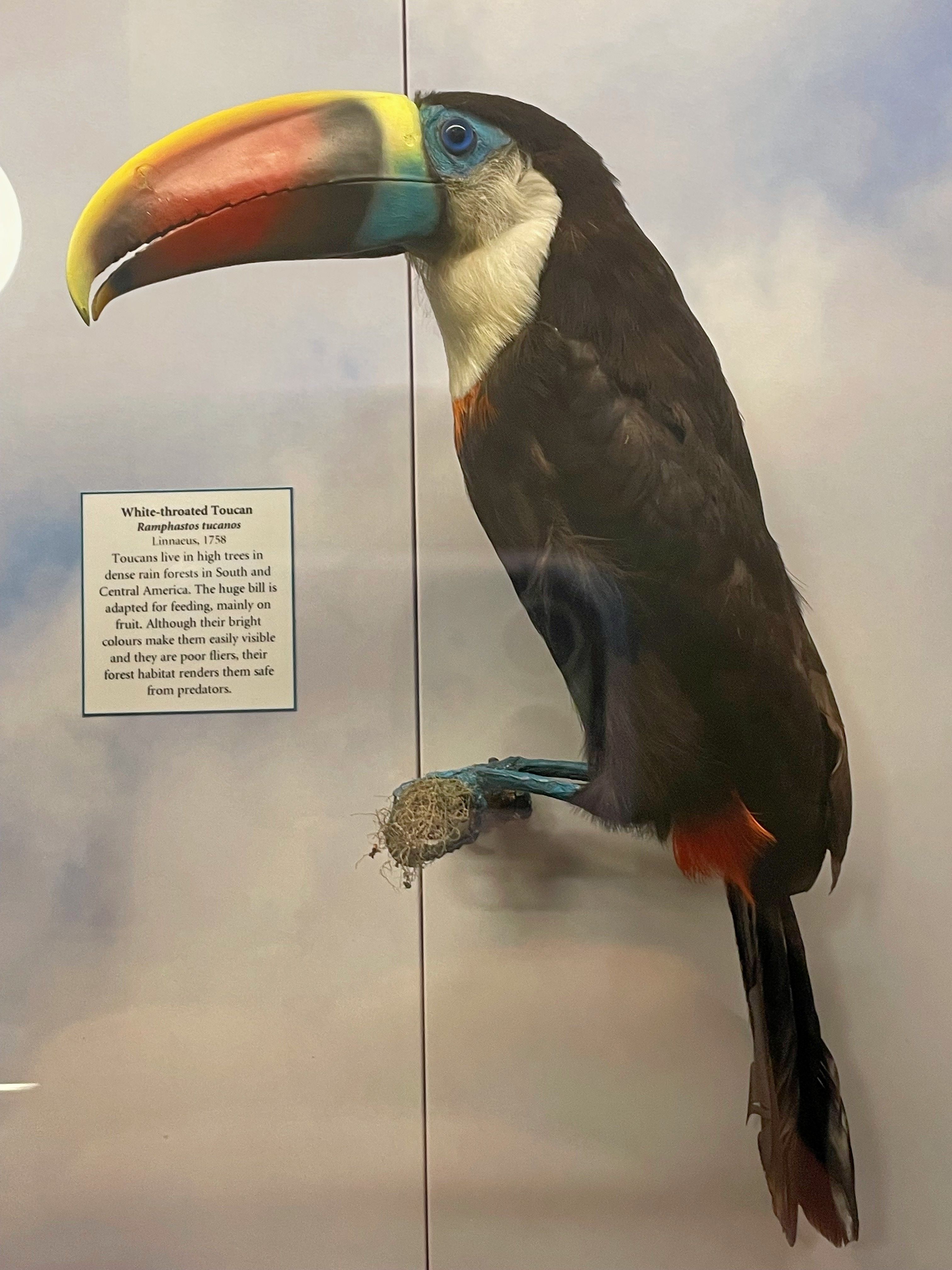
White-billed toucan (Ramphastos tucanus) taxidermy, OUNHM
White-billed toucan (Ramphastos tucanus) taxidermy, OUNHM
White-Billed Toucan
Ramphastos tucanus
White-billed toucans are found throughout the rainforests of Central and South America. They are extremely noisy birds, whose yelping calls echo across humid lowland forests. Males and females may perform duets together, the female’s call distinguishable from the male’s by its higher pitch.
White-Throated Toucan call. Source: Niels Krabbe via xeno-canto.org
What this specimen shows really well is the toucan's distinctive large bill. Massive and brightly coloured, but surprisingly light due to a porous honey-comb structure, there has been much debate about the role of this distinctive appendage. Some researchers thought its large size and vibrant colour was used for sexual display, others thought it may help the birds to reach hard to reach fruits in the canopy. Recent research in fact shows that its primary benefit might be to help toucans regulate their body temperature, a necessary feature for living in hot, humid forests.
You can see on this specimen that the bright colours of the toucan's bill and eye-catching blue legs have been rejuvenated with coloured paint. Creating taxidermy is not just a scientific preservation technique, but a highly skilled and artistic practice. The role of the taxidermist is often about making creative interventions to try and recreate the appearance of the living animal when the original materials provided by the dead specimen can no longer do so.
Though its bill may be its most distinctive feature, take a look at the small area of red and yellows feathers on its rump. We will see these feathers again when we look at Indigenous featherworks next door, particularly in objects made by the Shuar people of Southern Ecuador. Note how few feathers of this colour a single bird has because it will really put into perspective the number of birds that must have been used to create some of the objects we will see later.
The Shuar name for toucan is tsukanka. They are often represented in Shuar songs and poetry, known as ánents or nampet. These are sung by women to express emotion or to manifest particular fortunes in the future. Toucans often appear as symbols for love and desire, expressed by both men and women, perhaps mirroring the duets the tsukanka sing in the forest.
This video shared by Nathaly Shacay shows a tsukanka responding to its song
Having gathered around the "Adaptation" case on the right hand wall of the museum, where the White-throated Toucan is located, we now walk towards the entrance of the Pitt Rivers Museum at the back of the museum, opposite which is a faded and somewhat moth-eaten diorama labeled "South American Birds"
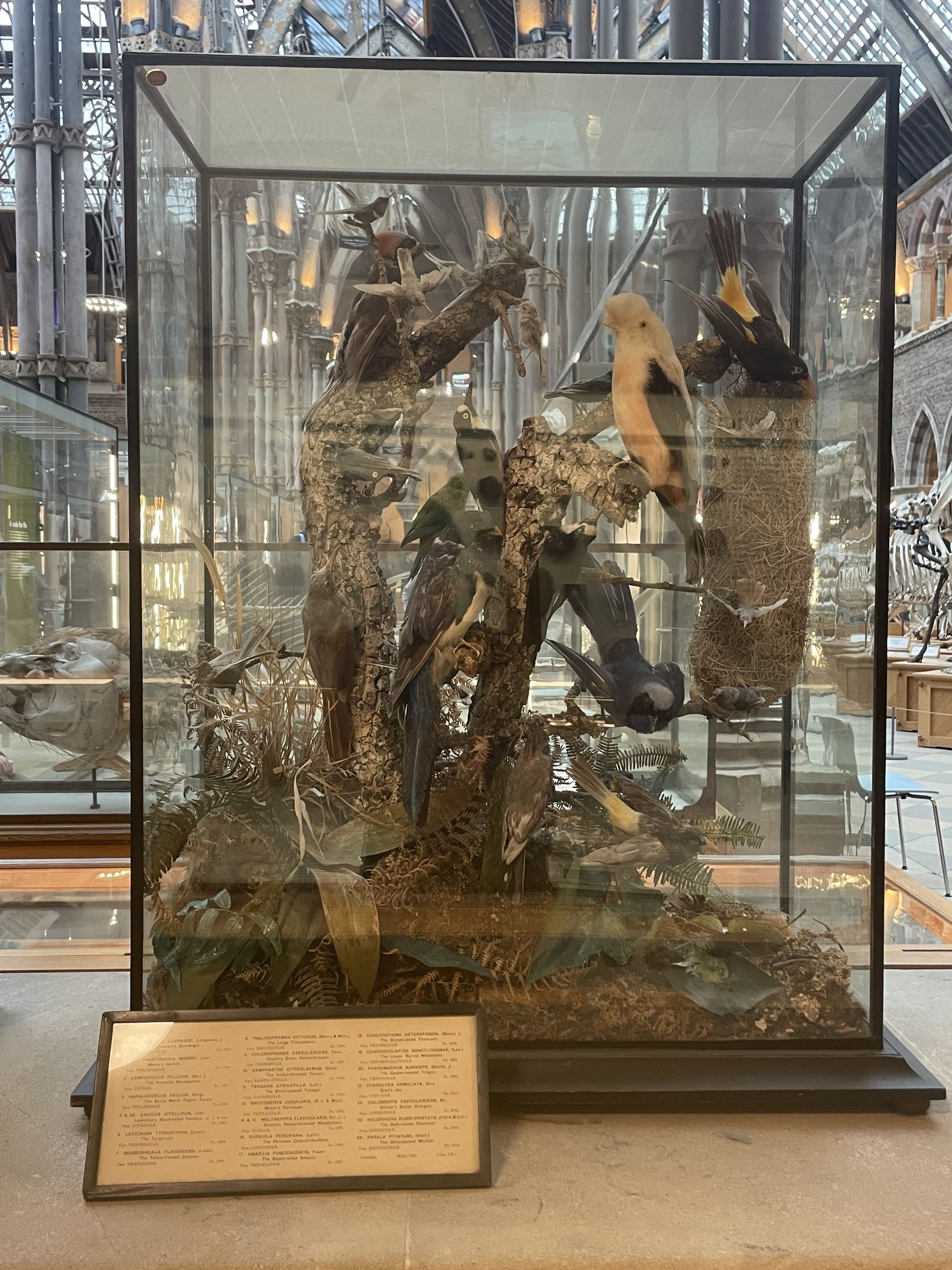
South American Bird Diorama
Dioramas like this first emerged at the end of the 19th century in Europe and North America and were designed to try and recreate a more situated sense of how animals might have lived and behaved when alive. The age of this case is showing in the faded appearance of the specimens inside.
Materials like feathers are particularly difficult to preserve, and often suffer from damage caused by light or pests which over time can lead to the specimens looking much less vibrant than they would have been in life. Pests such as the larvae of webbing-clothes moths (Tineola bisselliella) are particularly partial to keratin-based materials like feathers, and staff have to work hard to control their populations within museum buildings.

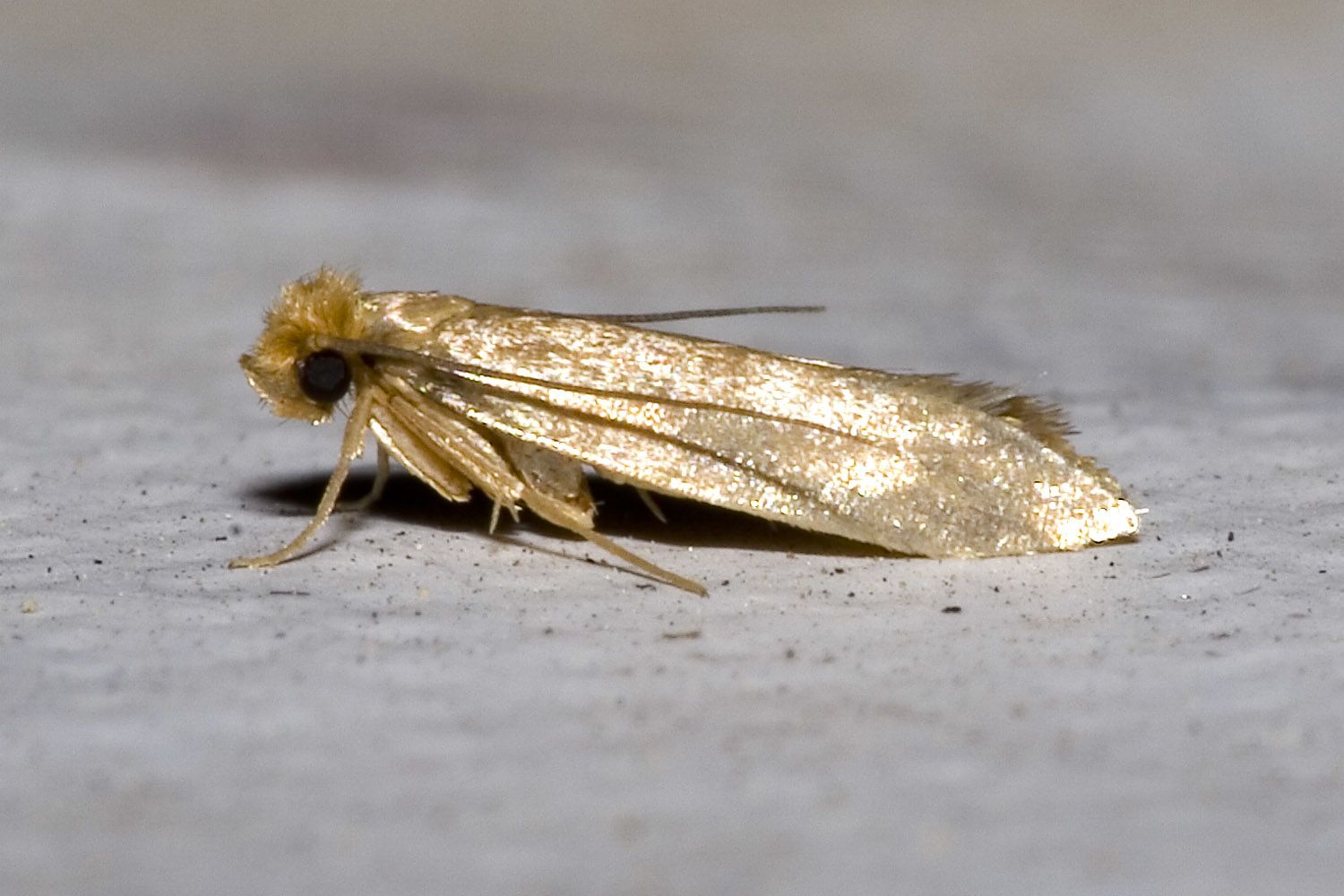
Webbing clothes moths. Image by Olaf Lillinger
Webbing clothes moths. Image by Olaf Lillinger
This Andean cock-of-the-rock (Rupicola peruvianus) in particular is looking very anaemic compared to how it would have appeared in life, likely faded from light exposure.

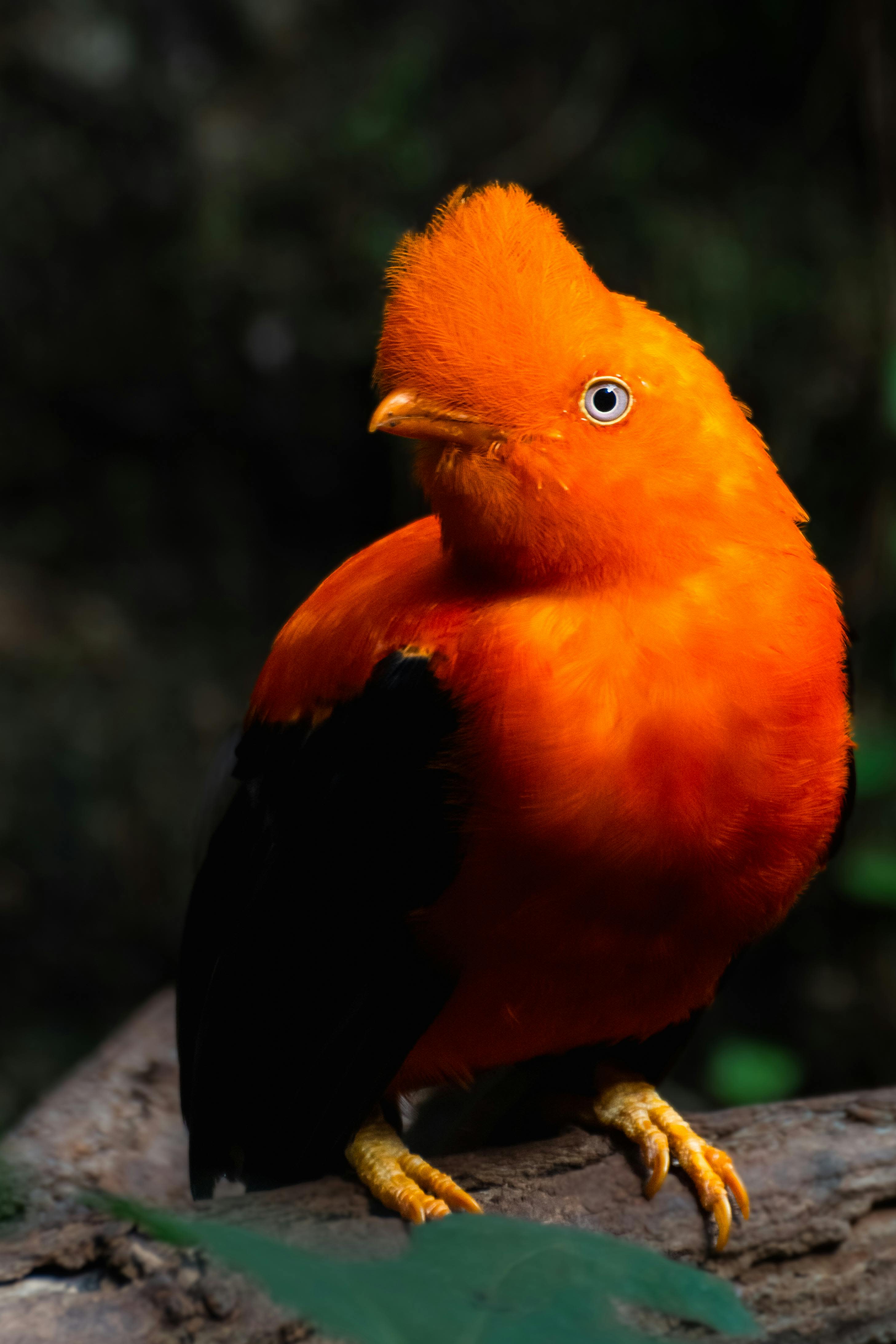
Andean cock-of-the-rock (Rupicola peruvianus). Source: Davide Negro
Andean cock-of-the-rock (Rupicola peruvianus). Source: Davide Negro
The diorama's label in itself tells an interesting story. If you are familiar with South American birds, you may notice that some of the names given here no longer reflect current taxonomic standards. For example, Cacicus vitellinus, listed here as Lawrence's Black-Tailed Cacique, is now considered a subspecies of Cacicus cela, the Yellow-Rumped Cacique.
Taxonomy is constantly evolving and genetic sequencing has transformed how we approach classification. It can reveal that what was once considered a single species should be split into several, or that apparently distinct species are closely related enough to be merged (a process known as "lumping" and "splitting"). This label is a snapshot of past forms of classification, which reminds us that although scientific taxonomy is often presented as objective, fixed or universal compared to other knowledge systems, it is also an ongoing and negotiated process.
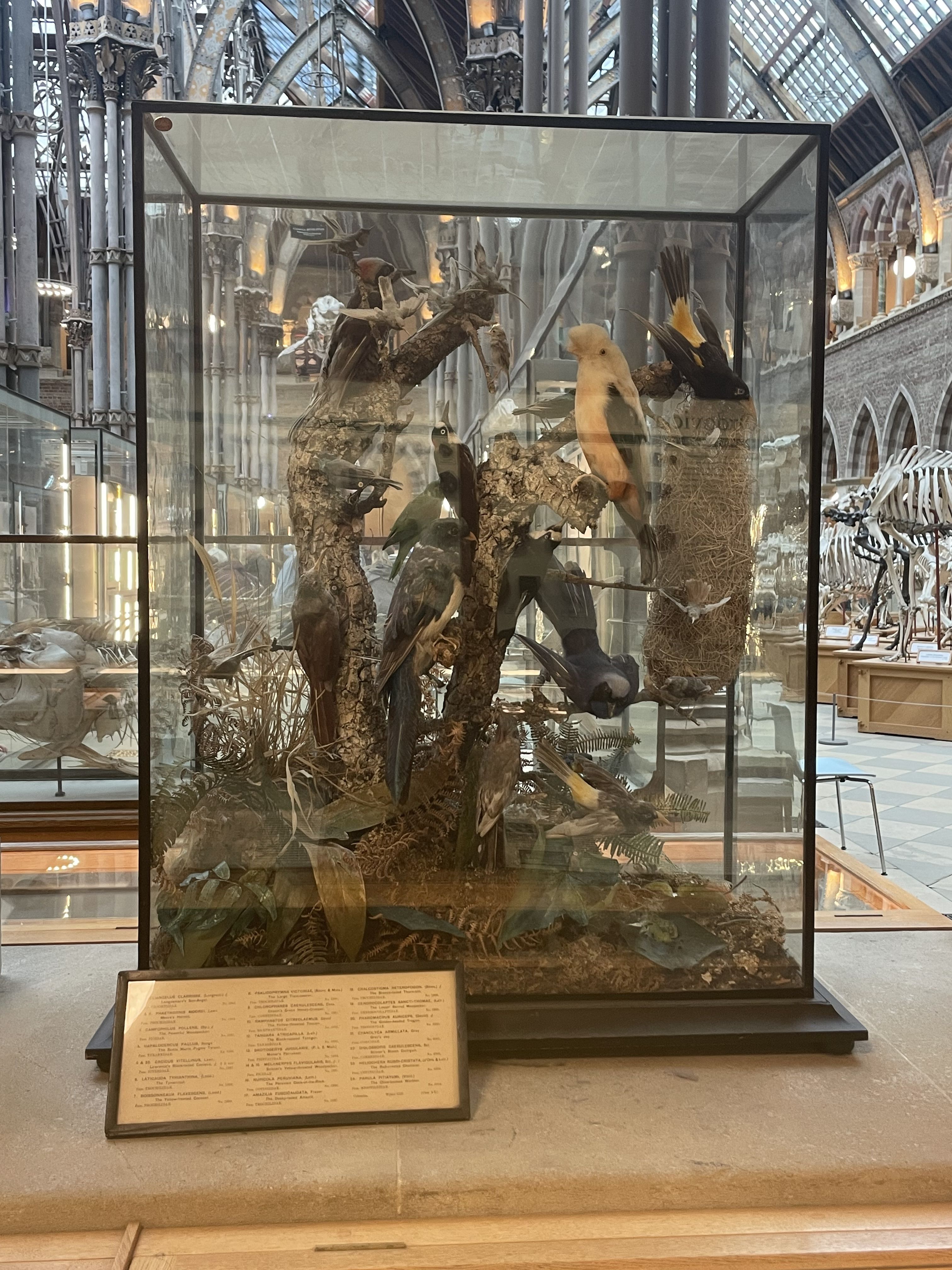
South American bird diorama, OUNHM
South American bird diorama, OUNHM
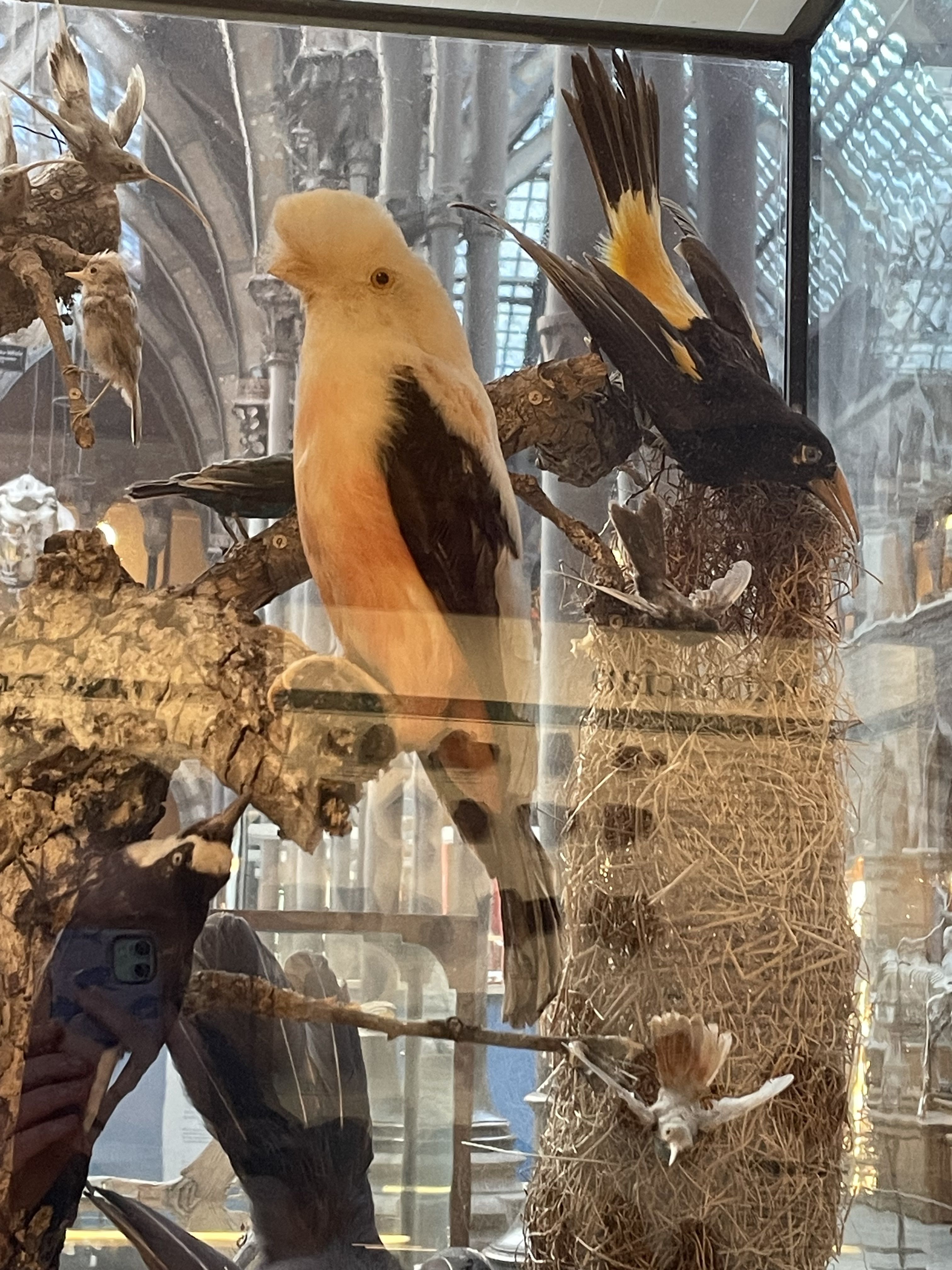
A faded Andean cock-of-the-rock
A faded Andean cock-of-the-rock
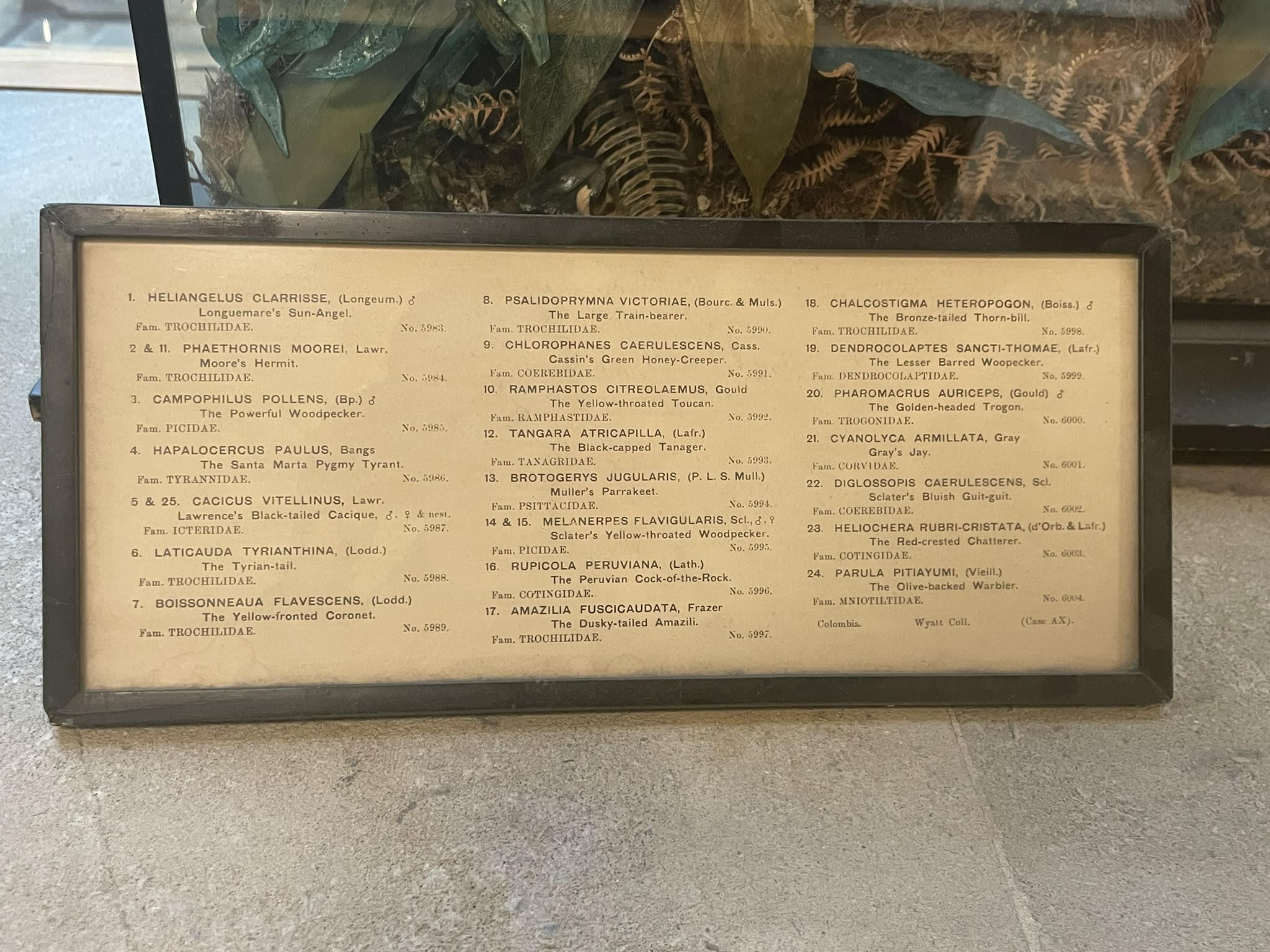
The original label for the diorama, showing several names now considered outdated
The original label for the diorama, showing several names now considered outdated
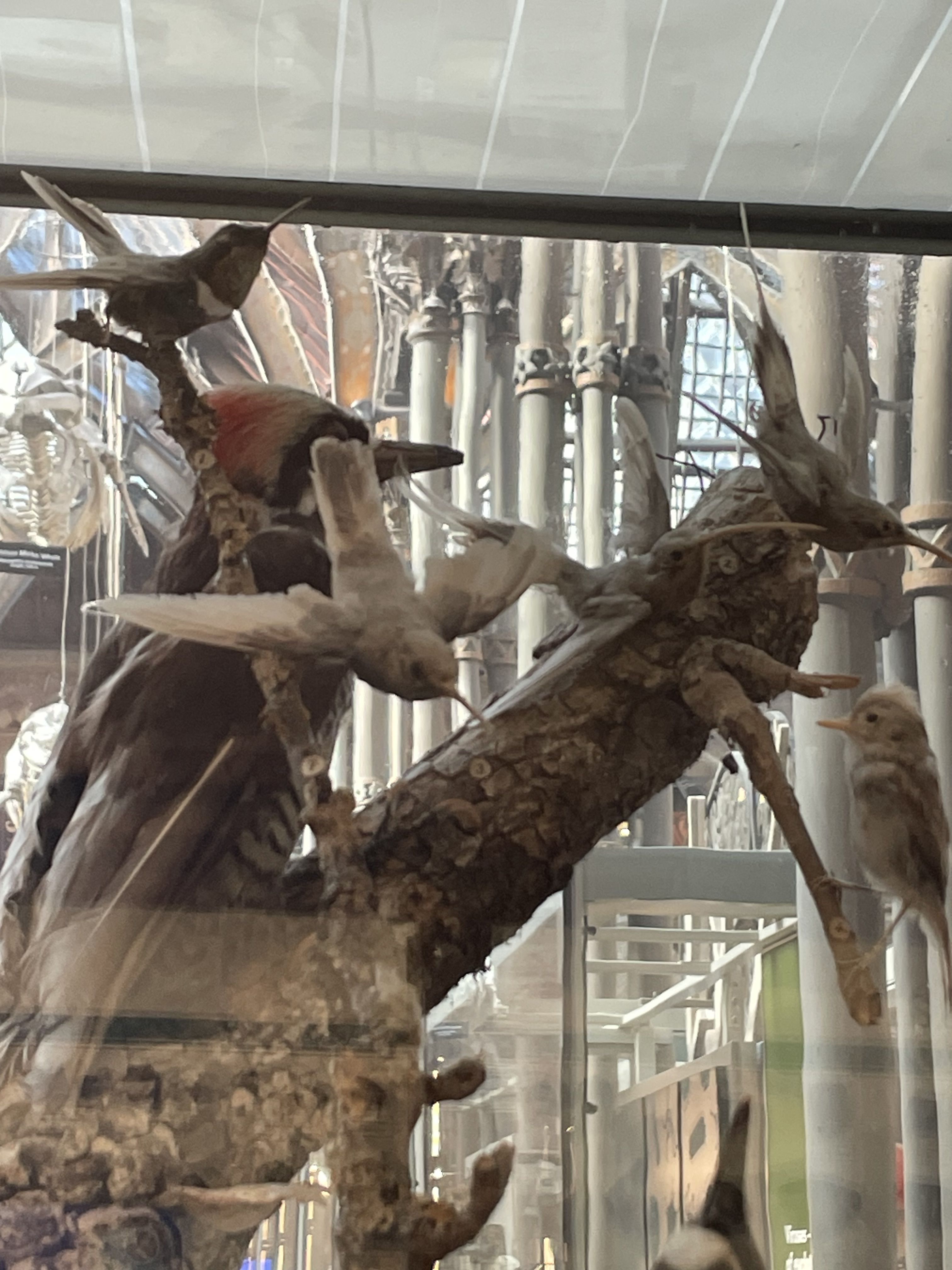
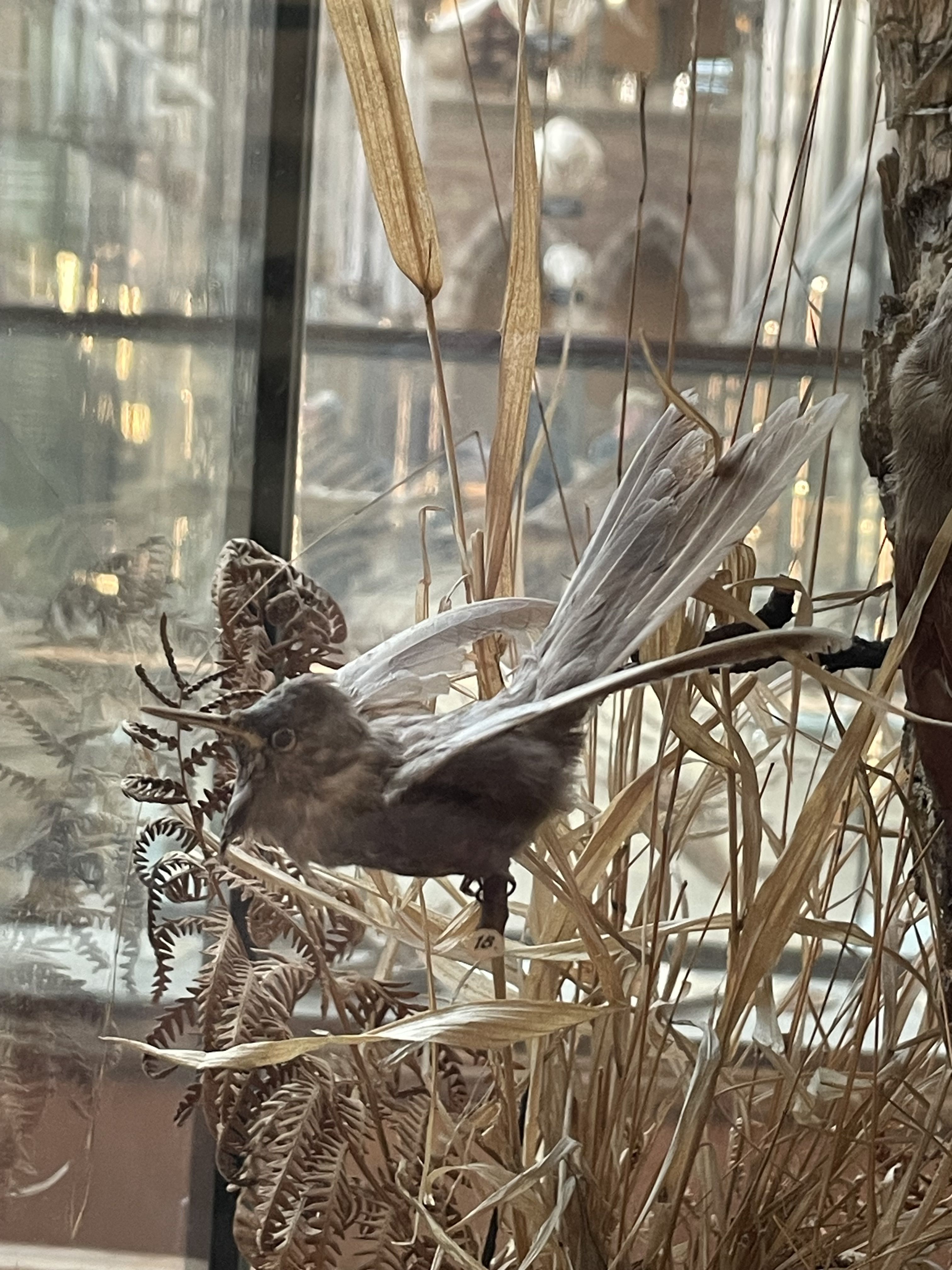
Hummingbirds
Trochilidae sp.
If you look in the top corner of the diorama, you will see six tiny hummingbirds perched next to each other. Native to the Americas, there are found all the way from Alaska to the Tierra del Fuego. The majority of species live within Central and South America.

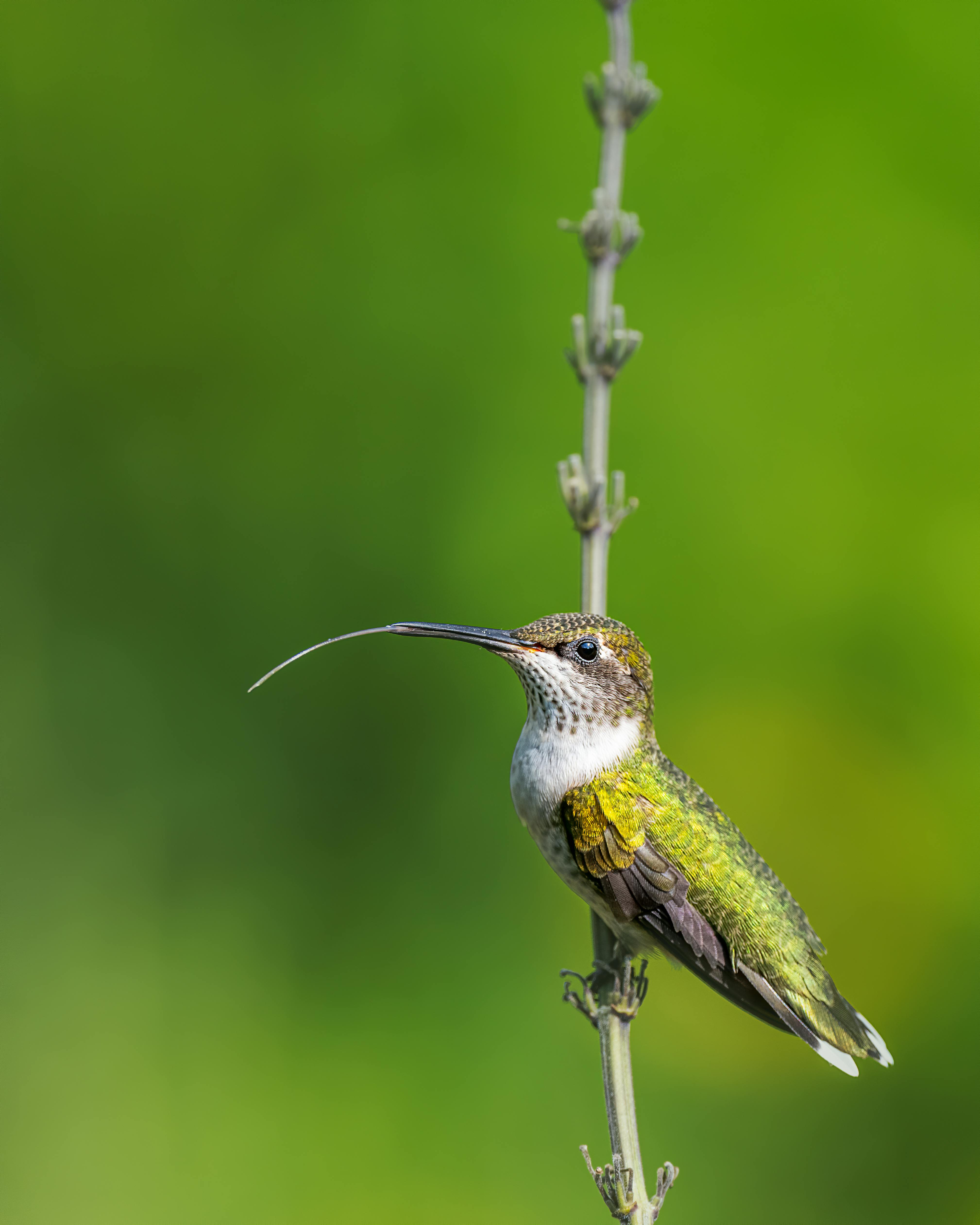
The long tubular tongue of a hummingbird. Photo by Skyler Ewing
The long tubular tongue of a hummingbird. Photo by Skyler Ewing
Hummingbirds are the world’s smallest but perhaps most extraordinary birds. They have the fastest metabolism of any bird, their hearts beat around 1,200 times a minute and their bodies can reach temperatures of over 40 degree Celsius! They are mostly nectivorous, living off a high energy sugar diet of flower nectar, which requires them to be constantly feeding when they are active during the daytime. This high-speed life requires them to be hugely acrobatic flyers, they flit around at high speed (30- 60 mph), beating their wings up to 80 times a second to enable them to hover in front of flowers and lick up their nectar with their highly specialised tube-shaped tongues.
Hummingbirds are often represented as delicate, dainty creatures in Western art and culture, but they are actually often very feisty and aggressive. They are highly territorial and will fiercely guard flowers or hummingbird feeders against rivals. Some species even have serrated edges on their beaks to enable them to defend their resources.

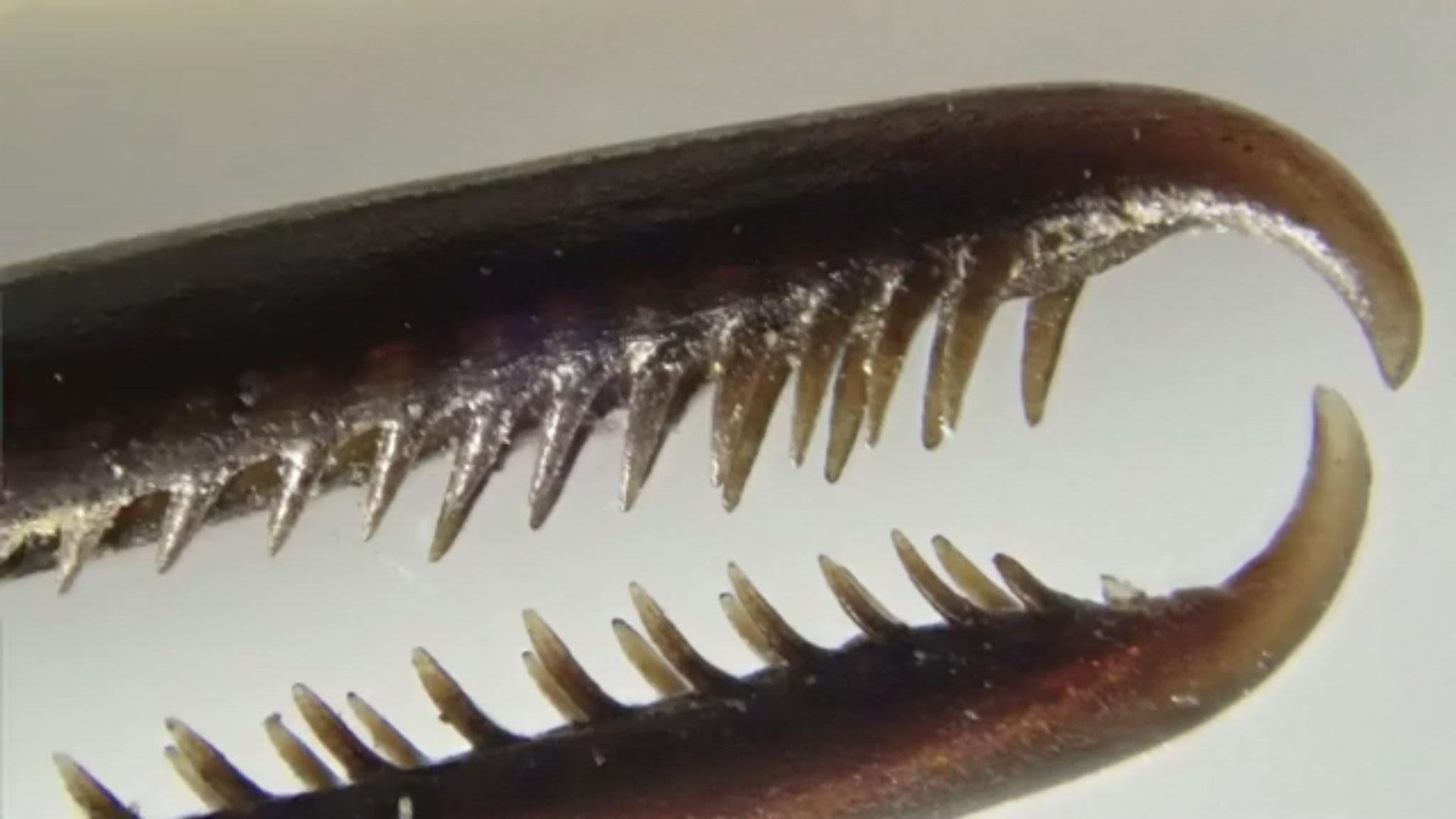
The serrated "teeth" of a hummingbird bill (Source: UC Berkeley via SkyNews
The serrated "teeth" of a hummingbird bill (Source: UC Berkeley via SkyNews
An Allen's hummingbird (Selasphorus sasin) defending a feeder from a rival. Video from HummingbirdChannel
Latin American mythologies reflect the tenacious nature of hummingbirds, where they are often represented as highly resourceful, acrobatic warrior birds, often associated with combat, life, death and fertility. For example, among the Aztec peoples in Mexico, the hummingbird was seen as a warrior, who used his sharp bill and agility to win battles against enemies. Those who died in battle were sometimes believed to return as hummingbirds.

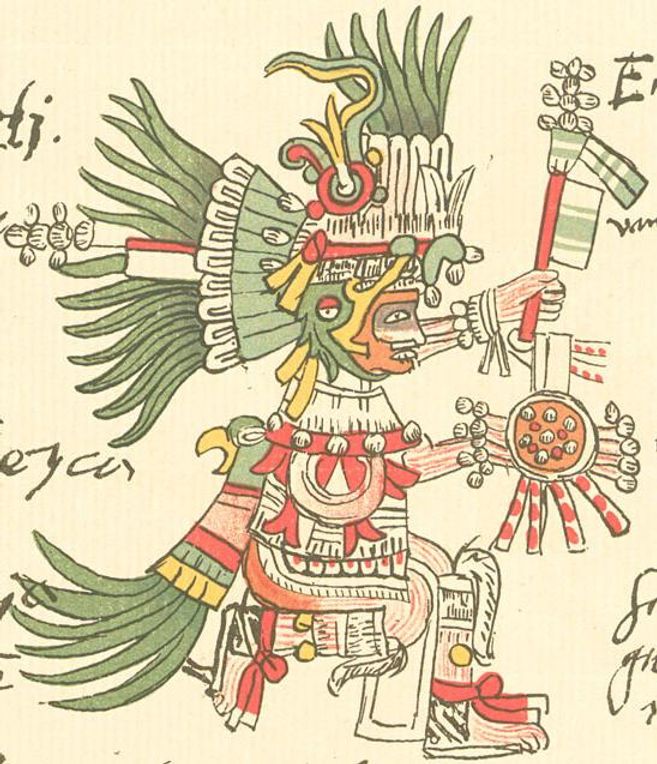
Representation of the Aztec god Huitzilopochtli from the Codex Telleriano-Remensis (16th century), associated with hummingbirds
Representation of the Aztec god Huitzilopochtli from the Codex Telleriano-Remensis (16th century), associated with hummingbirds
In this diorama however, their passive and delicate image endures in how they have been positioned in taxidermy form, perched together in harmony with other birds. In reality, a lot of squabbling would be taking place if these birds suddenly reanimated!
Scarlet Ibis
Eudocimus ruber
Scarlet Ibis mostly inhabit northern wetland and mangrove areas of South America. They are renowned for their brilliant red plumage, which like flamingos, is related to the carotenoid pigments they get from their diets of crustaceans and shrimps.

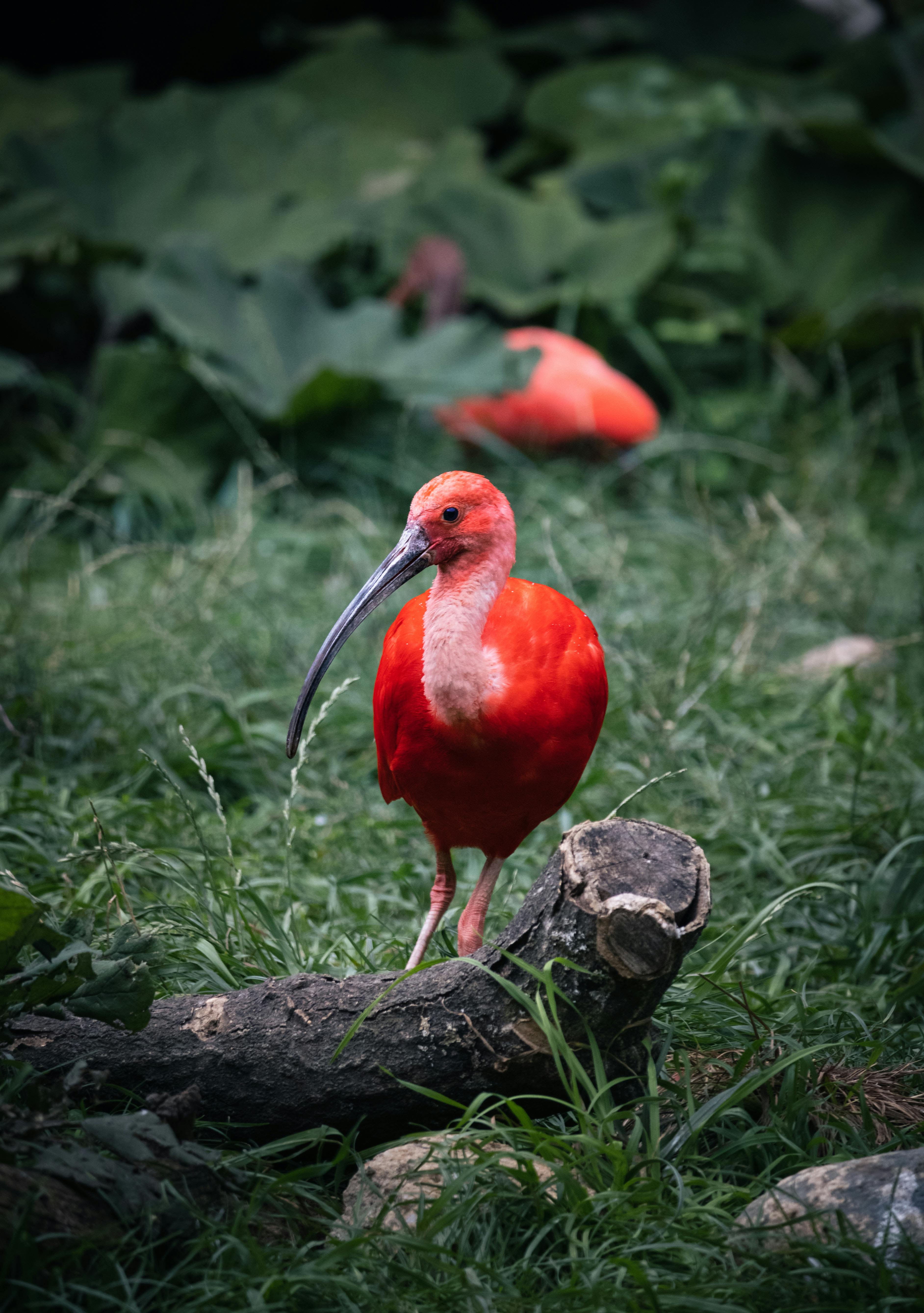
Scarlet ibis. Photo by Niklas Jeromin
Scarlet ibis. Photo by Niklas Jeromin
The beautiful colour of the scarlet ibis was noted by the first Europeans in South America in the 16th century, where their feathers were observed on beautifully intricate feather cloaks made by the Tupinambá people on the coast of Brazil. The ibis are known as guará.

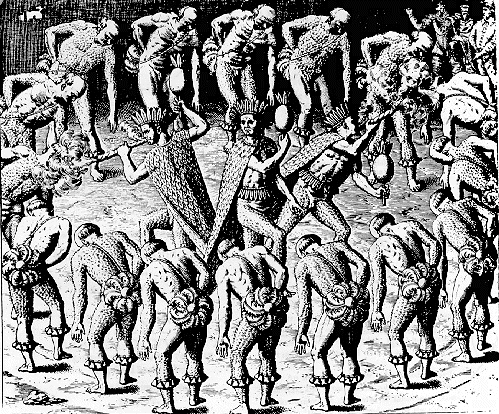
16th century depiction of Tupinambá cloaks, Hans Staden (1552)
16th century depiction of Tupinambá cloaks, Hans Staden (1552)

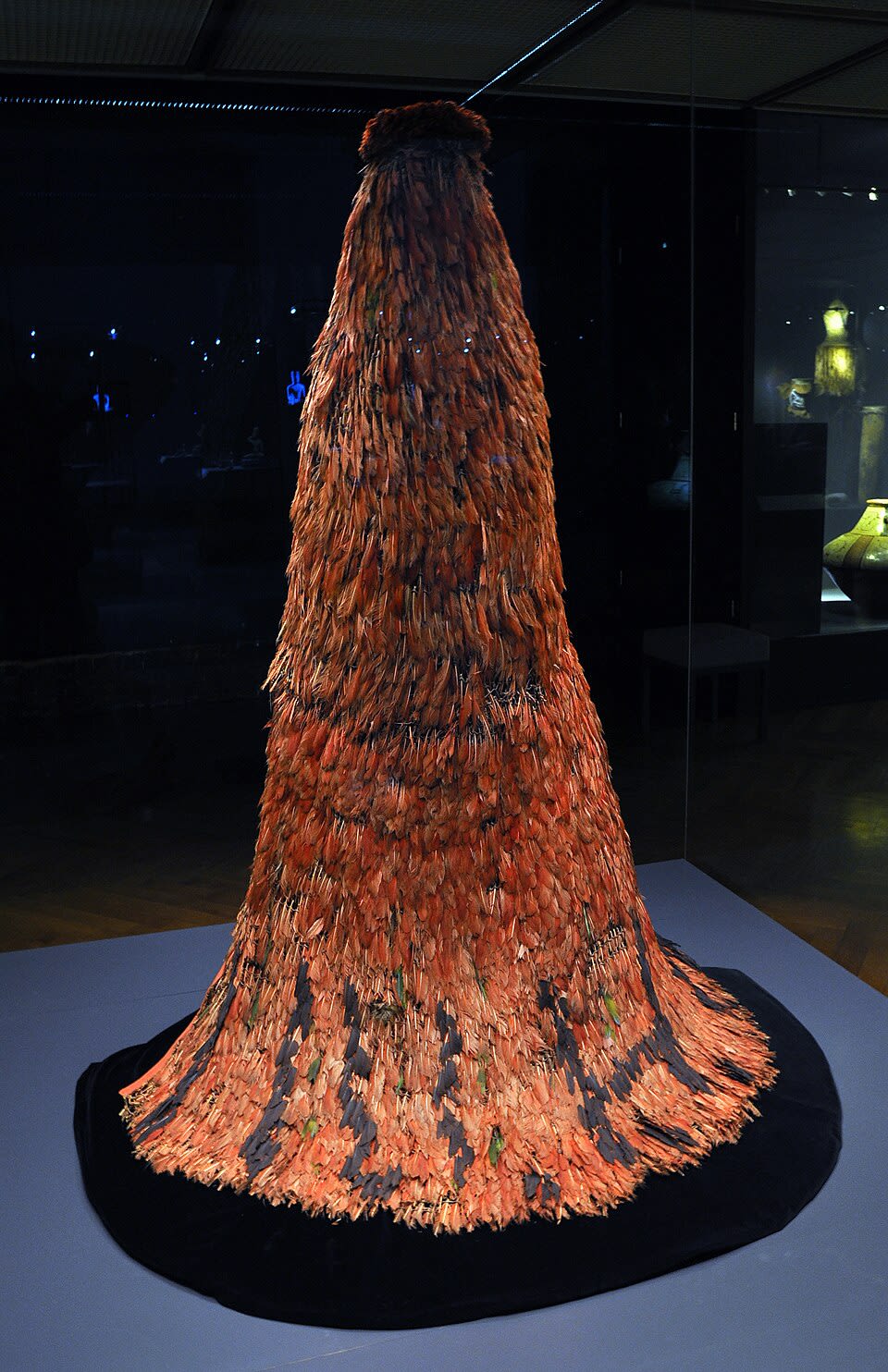
A Tupinambá cloak in Brussells. Photo by Vassil
A Tupinambá cloak in Brussells. Photo by Vassil
One of the people working to revive the practice of making feather cloaks is Indigenous activist, researcher and artist Glicéria Tupinambá. By studying the feather cloaks held in European collections, she has woven her own intricate feather cloaks, created as gifts for the encantados, the "enchanted ones" who live within Tupinambá territory.
The guará no longer exists within Tupinamba territory, likely due to reasons such as the destruction of mangrove forests. Glicéria often uses feathers from other birds like chickens and ducks in her cloaks, collecting them from the ground as gifts given to her from the land.
In 2023, Glicéria visited Oxford to examine some of the featherworks in the Pitt Rivers Museum. By studying the techniques of weaving and knotting present in the objects, she is able to recreate new featherworks back in her community in Brazil.

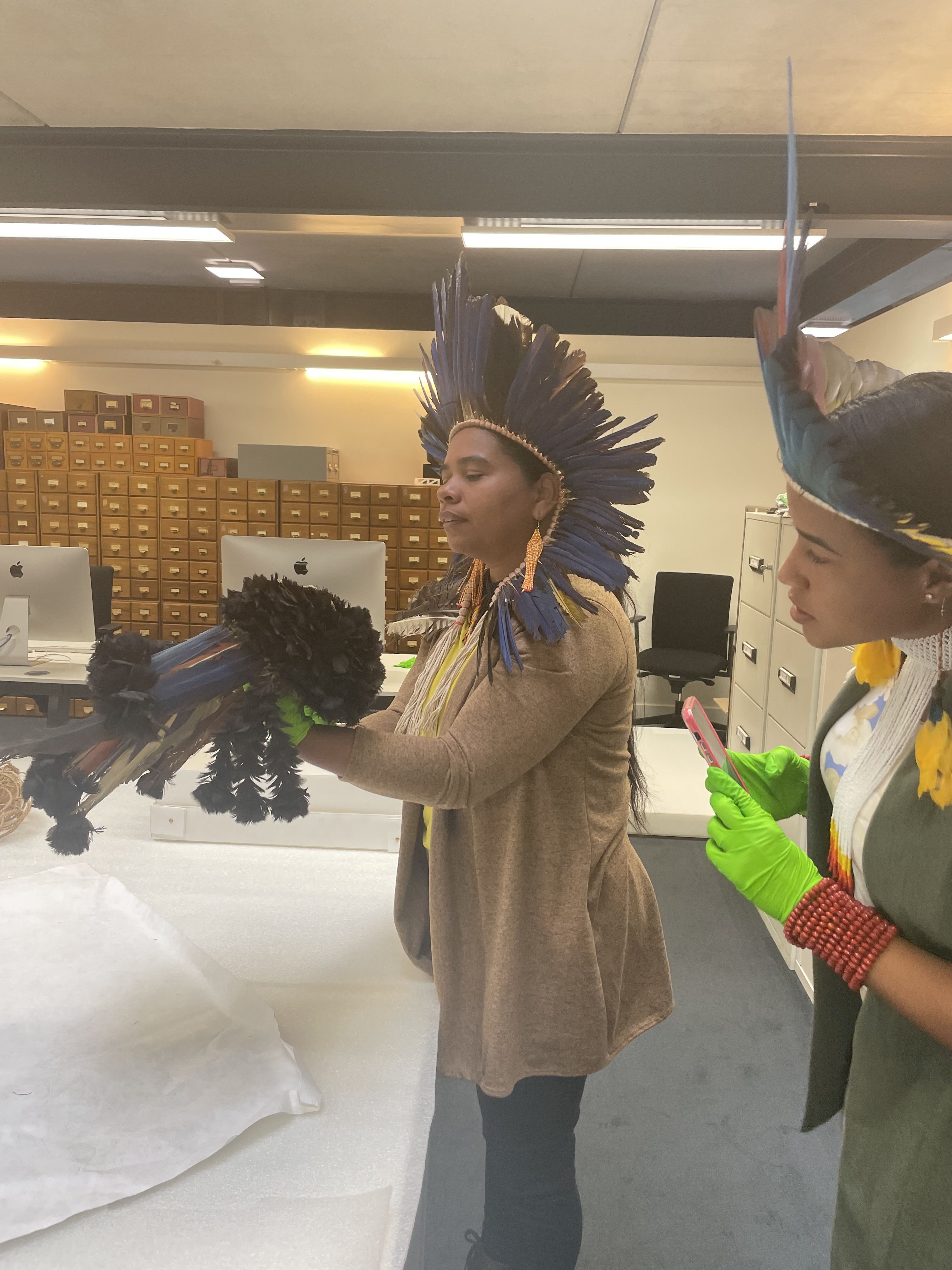
Glicéria Tupinambá meeting with featherwork collections at the Pitt Rivers Museum in 2022
Glicéria Tupinambá meeting with featherwork collections at the Pitt Rivers Museum in 2022
Collaborating with Indigenous researchers and community members is one of the most important aspects of museum work today. Working with people like Glicéria aims to reinvigorate the museum's collections in new ways, and generate new kinds of knowledge about objects beyond that which is present in the written records of the museum.
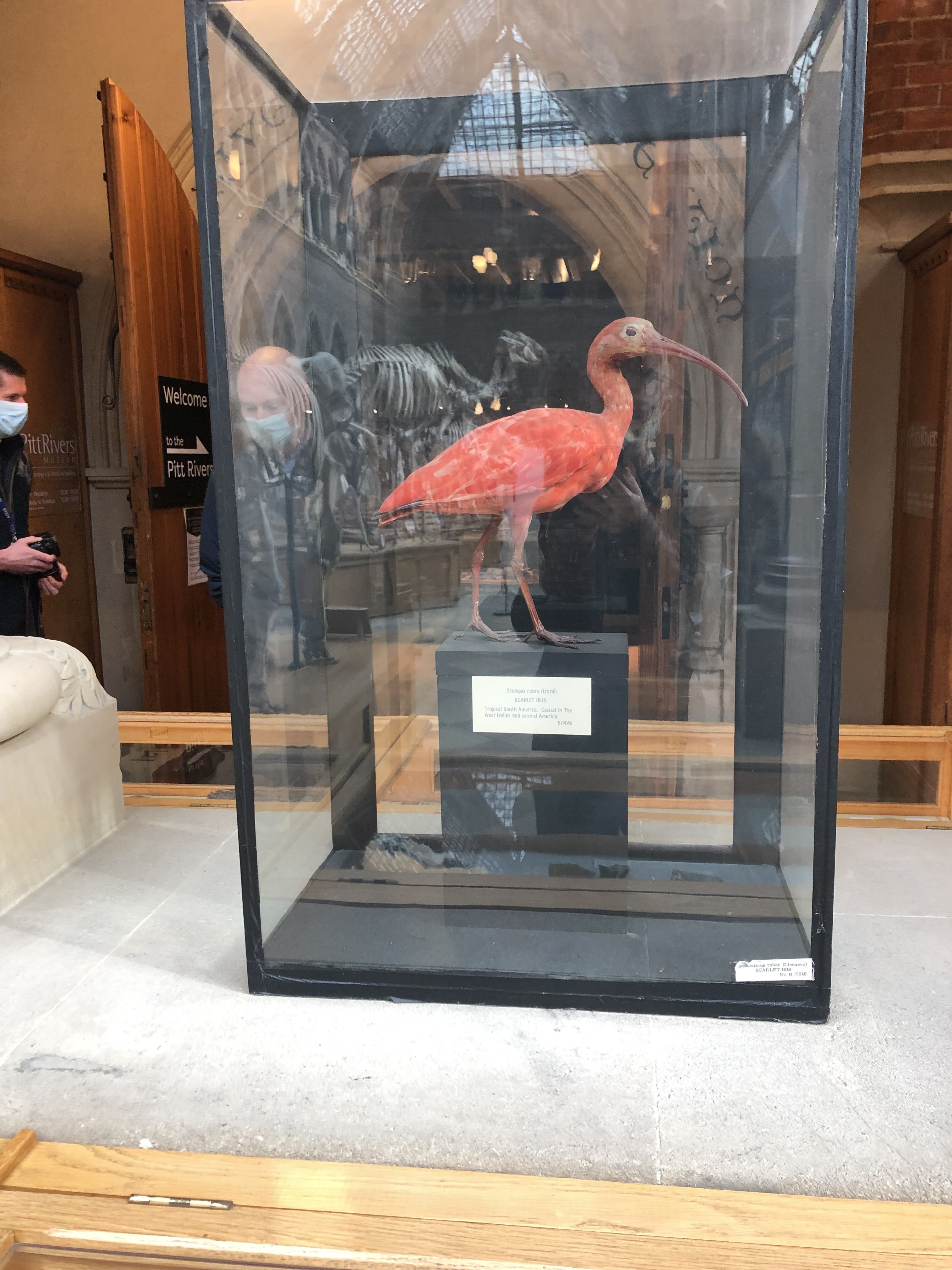
Scarlet Ibis (Eudocimus ruber), Oxford University Natural History Museum
Scarlet Ibis (Eudocimus ruber), Oxford University Natural History Museum
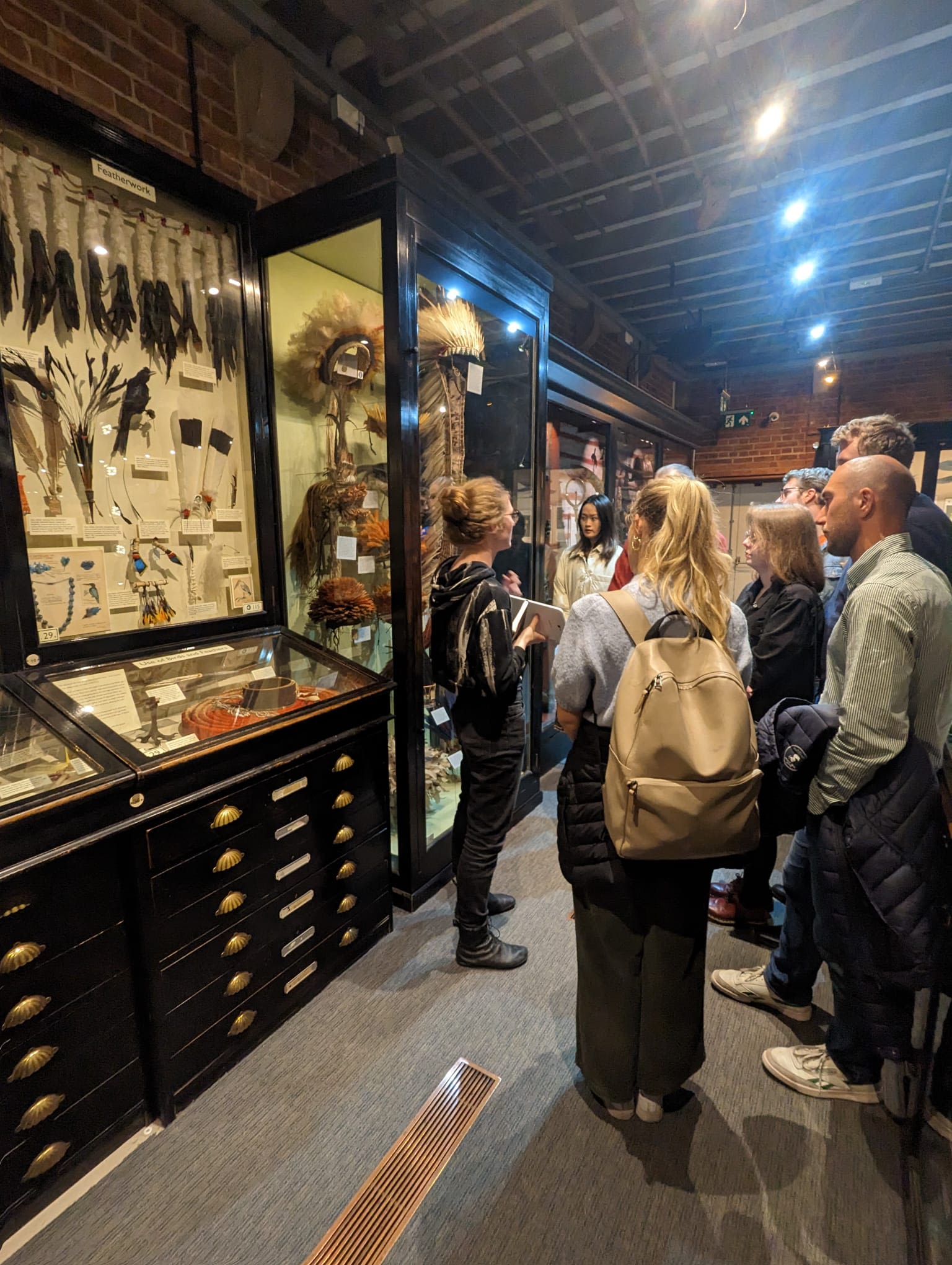
We now walk our way from the OUNHM through a stone arch entrance and down the steps to enter the Pitt Rivers Museum. There is a markedly different atmosphere here. While the Natural History museum is brightly lit and spacious with orderly cases, the PRM is much darker and denser in its displays. The dark wood cabinets and closely packed arrangement typological arrangement of objects is much different from the generally sparser cases next door. As a group, we pass through the main floor and up the stairs to the Lower Gallery mezzanine, where the main Featherwork displays are located. At this point, if the group is not familiar with the PRM, I will give a brief introduction to the museum's history and "democracy of things" typological display system.
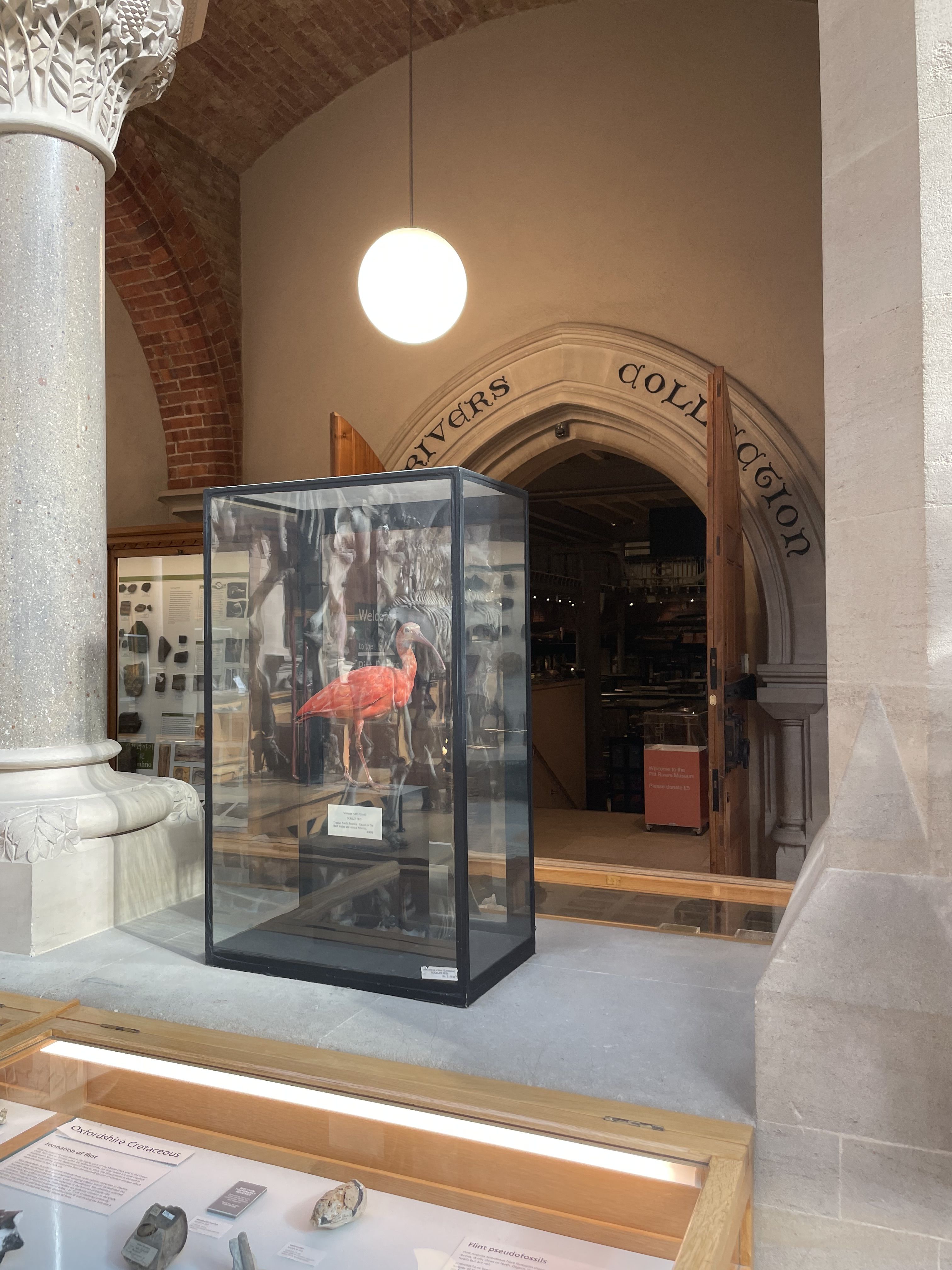
Entrance to the Pitt Rivers Museum from the OUNHM
Entrance to the Pitt Rivers Museum from the OUNHM
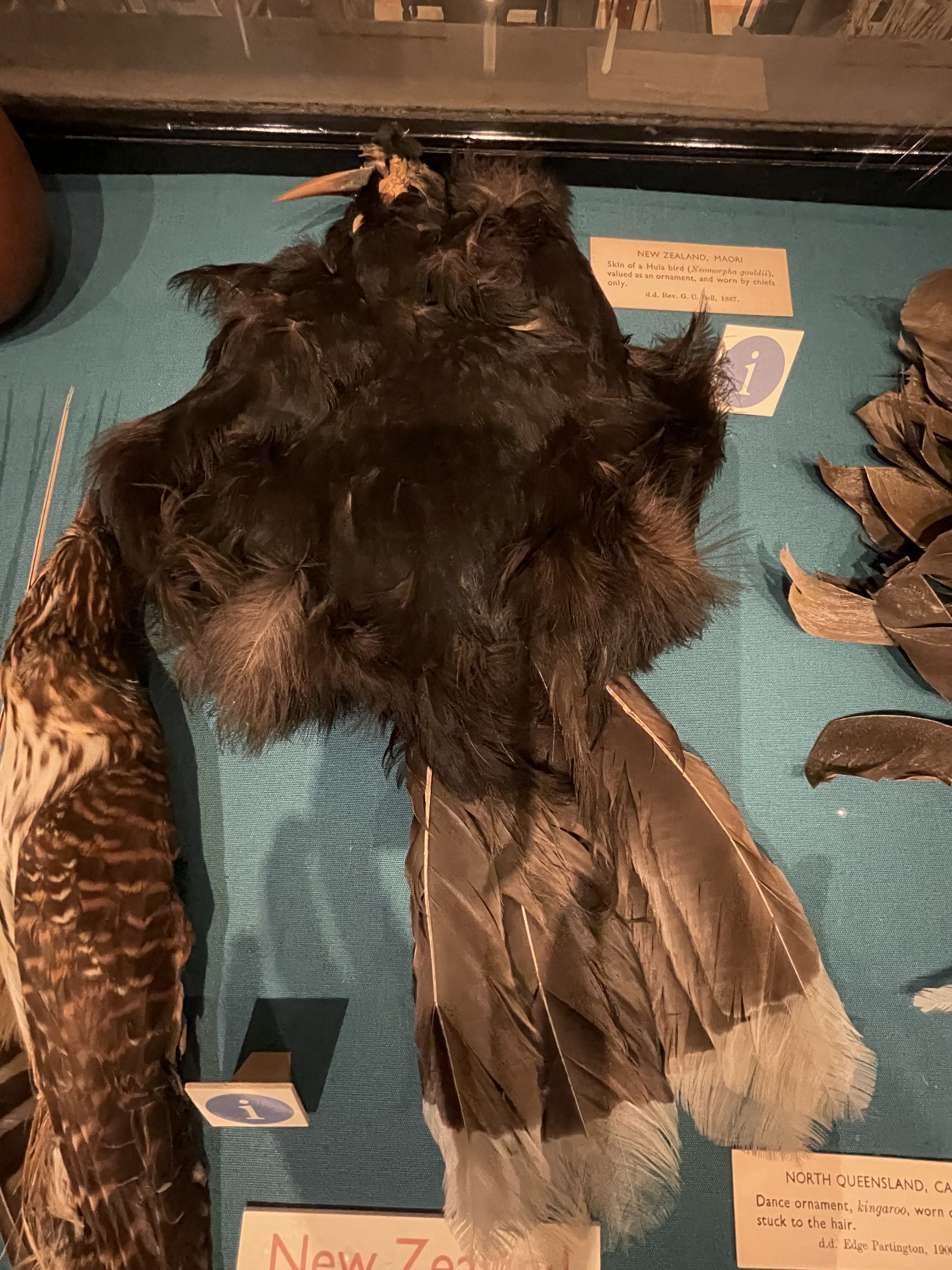
A Huia ear ornament
Heteralocha acutirostris
This ornament is perhaps one of the most poignant bird-objects present in the Pitt Rivers Museum because it is made from the skin of a now extinct bird from New Zealand/Aotearoa: the huia (Heteralocha acutirostris)

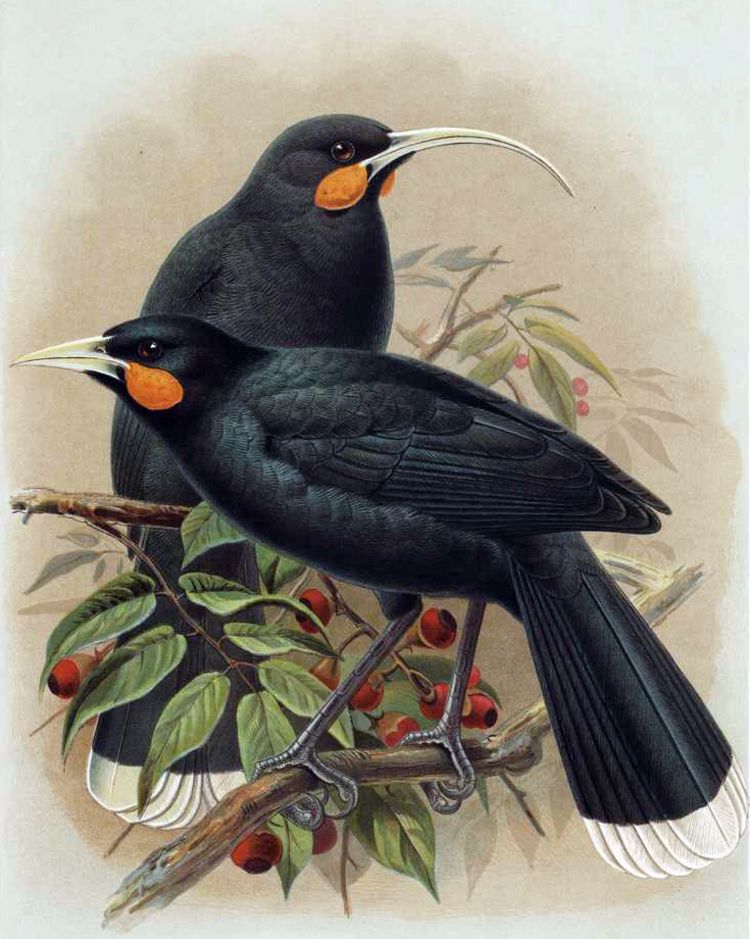
Male and female huia (Heteralocha acutirostris). Painting in Buller, Walter Lawry (1888) A History of the Birds of New Zealand, Volume 1. Public domain.
Male and female huia (Heteralocha acutirostris). Painting in Buller, Walter Lawry (1888) A History of the Birds of New Zealand, Volume 1. Public domain.
Found at ground level in forests, the huia were unique birds due to their extraordinary sexually dimorphic bill shapes. Working in mated pairs, the huia used their different beaks to co-operatively find food: the male would pierce holes in the side of rotting wood with his short, dagger-like bill and the female would then use her long curved-bill to scoop out grubs. If you look closely you can see that this specimen is a male huia.
The name “huia” most likely comes from the loud, whistling call the bird made in the forest. Maori hunters used to mimic this call in order to attract birds to them in order to capture them. While no recording of the huia’s call exists, we can gain an idea of what is sounded like from a hauntingly beautiful 1949 recording made by naturalist Henare Hāmana. Hāmana imitated the call from memory, recording this over 30 years on from when the huia was declared extinct.
The decline of the huia has been attributed to a number of factors. In some ways, the bird’s distinctive bill was also a contributor to its downfall, as naturalists from overseas soon became obsessed with obtaining specimens to showcase this unique characteristic in museums collections and hundreds of birds were killed and shipped abroad.

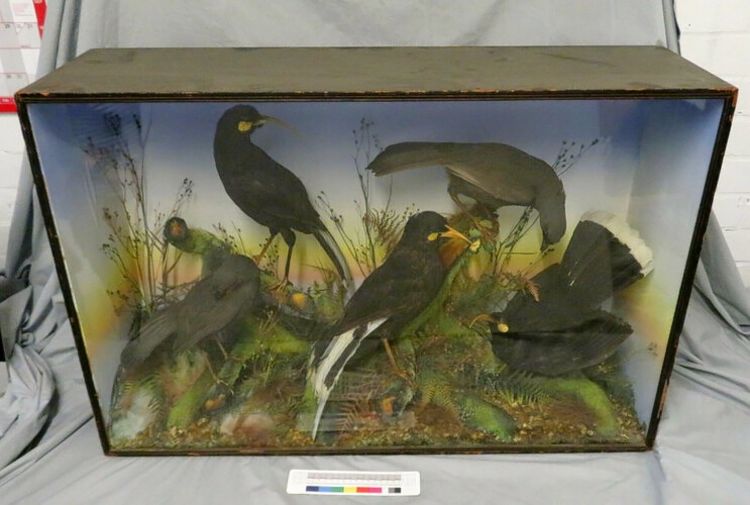
1923.87.254 Huia diorama, Pitt Rivers Museum
1923.87.254 Huia diorama, Pitt Rivers Museum
European fashion trends also contributed to the huia’s demise. On a visit to New Zealand in 1901, George V was presented with a black and white huia tail feather by a Maori spiritual leader, which he placed in the headband of his hat. Photos of the Duke and his befeathered hat were circulated back in England, where a fashion for huia feathers and beaks soon took off.

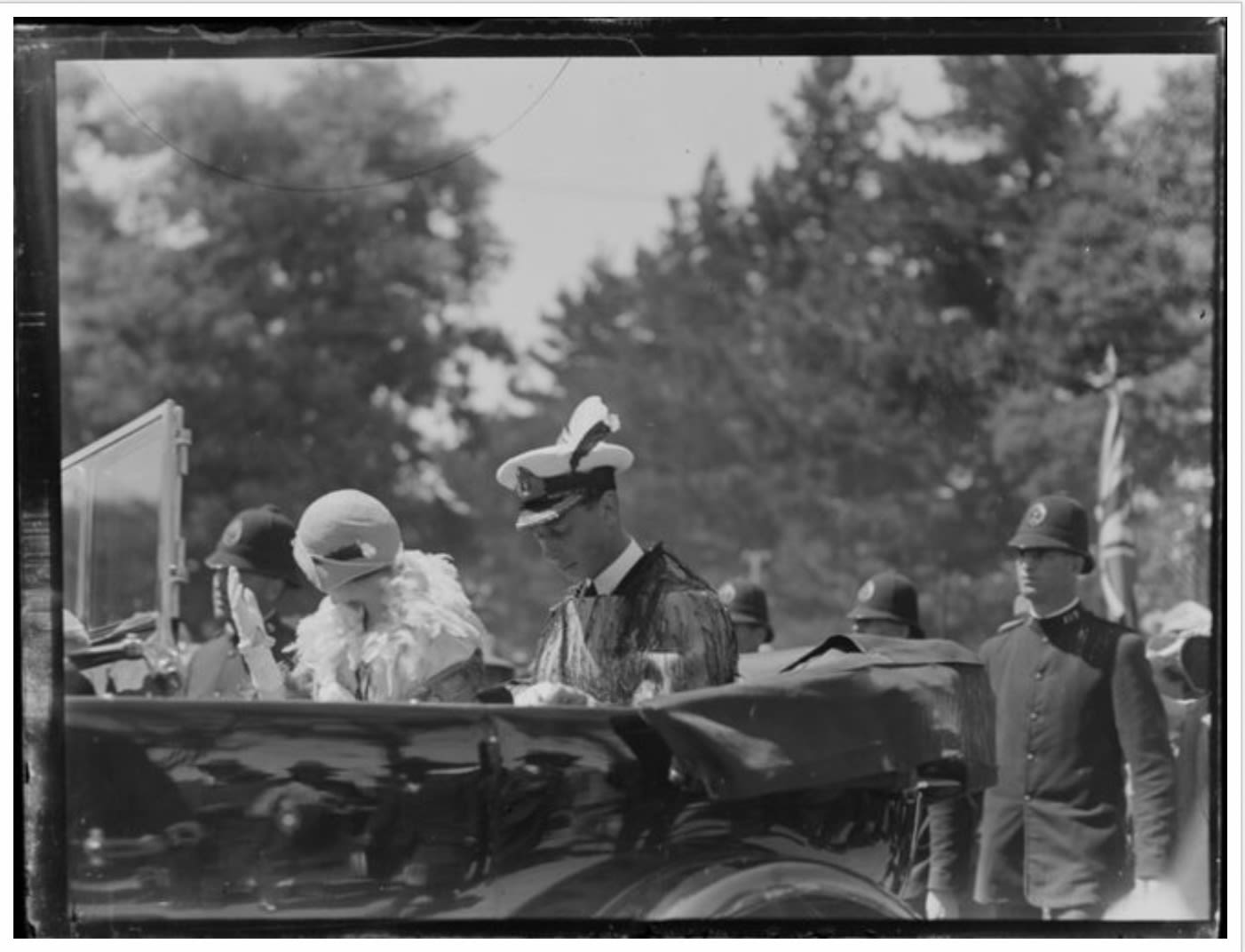
Duke and Duchess of York with huia feathers in their hats after a reception. Photo: Alexander Turnbull Library
Duke and Duchess of York with huia feathers in their hats after a reception. Photo: Alexander Turnbull Library
Maori communities became deeply concerned by these threats to the huia, and in the late 1800s a number of groups placed a tapu on large areas of the huia’s remaining habitat, forbidding hunting in these areas. The calls of the Maori did have an effect on the New Zealand government, and in 1892 plans were put in place to set up sanctuaries for the huia, however action was not taken quickly enough and the sanctuaries were never established. The last sighting of huia was recorded in 1907 and is now considered extinct.
Huia feathers are highly valued today, and in May 2024 a single feathers sold for over £22,000 at auction. The huia is a taonga (a sacred treasure) for the Indigenous peoples of Aotearoa, who still work to keep the spirits of the birds alive by treasuring their feathers in special boxes known as wakahuia, and by remembering and imitating their songs.

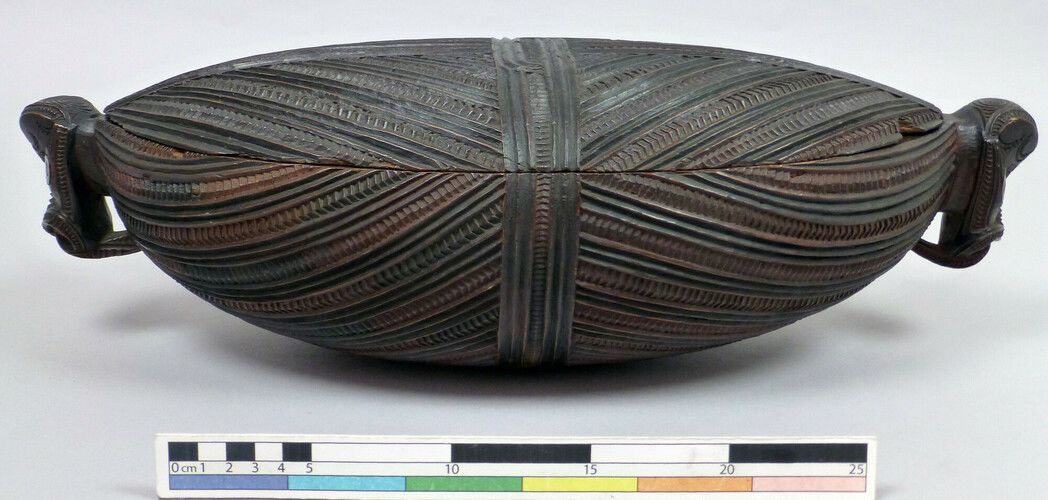
1933.82.1.1 A Maori feather box or wakahuia. Pitt Rivers Museum collection
1933.82.1.1 A Maori feather box or wakahuia. Pitt Rivers Museum collection
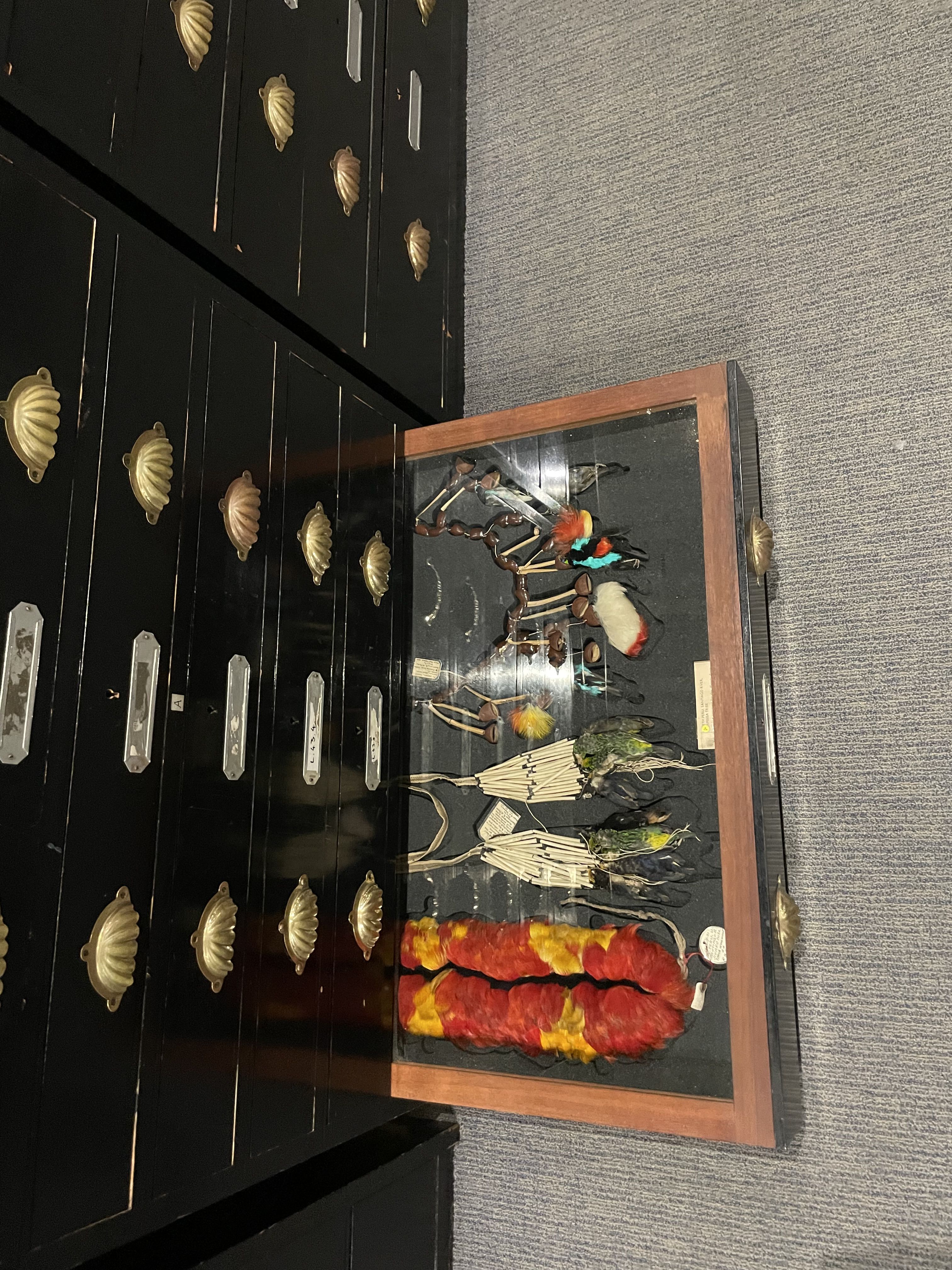
We move across from the huia and open a drawer at floor level. It reveals an array of feathered ornaments displayed on specially cut Plastazone foam mounts - the results of a project which took place in the museum in 2020 to present the collections in drawers as "viewable storage" more effectively.
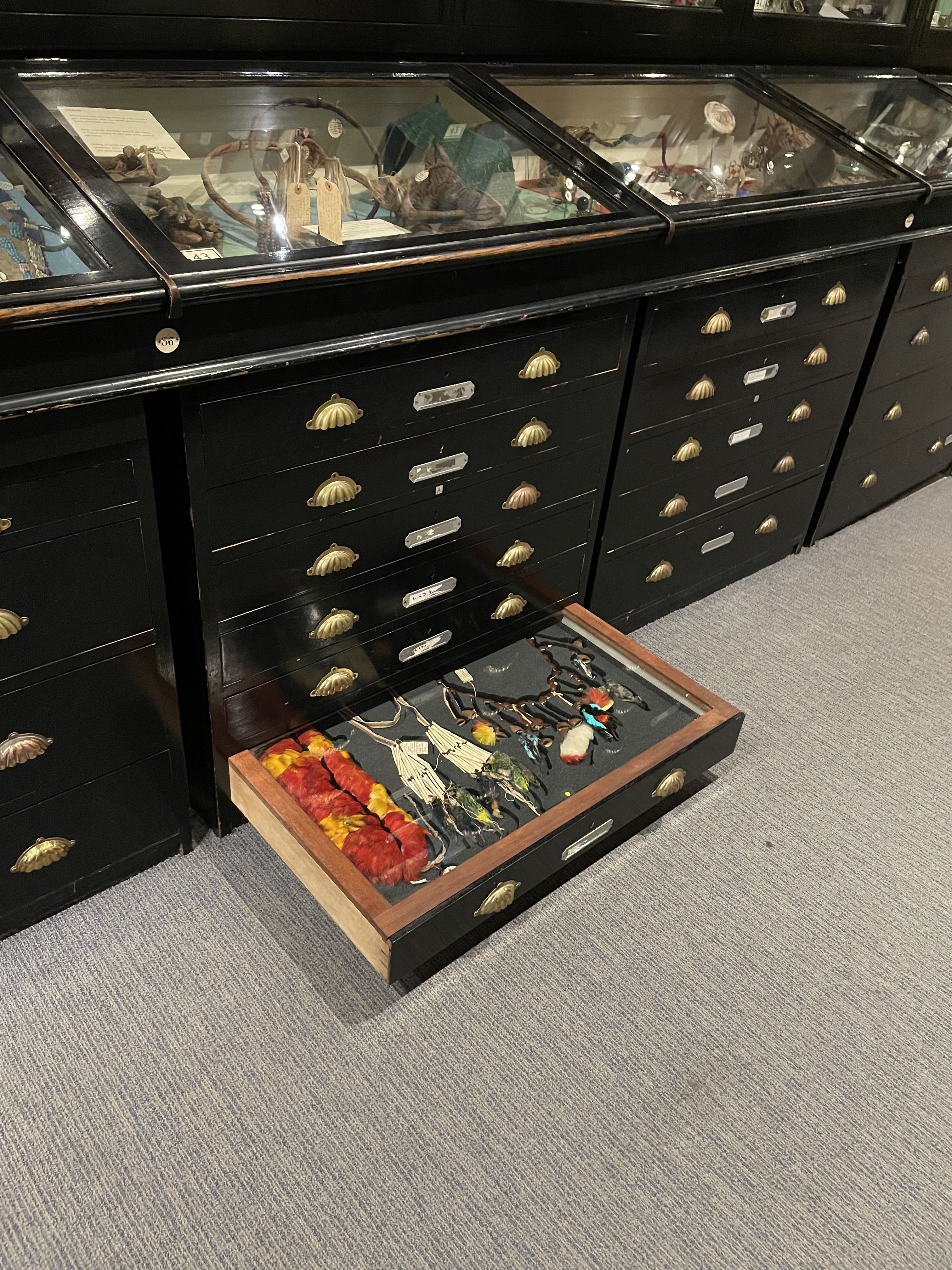
Featherwork drawer, Lower Gallery, Pitt Rivers Museum
Featherwork drawer, Lower Gallery, Pitt Rivers Museum
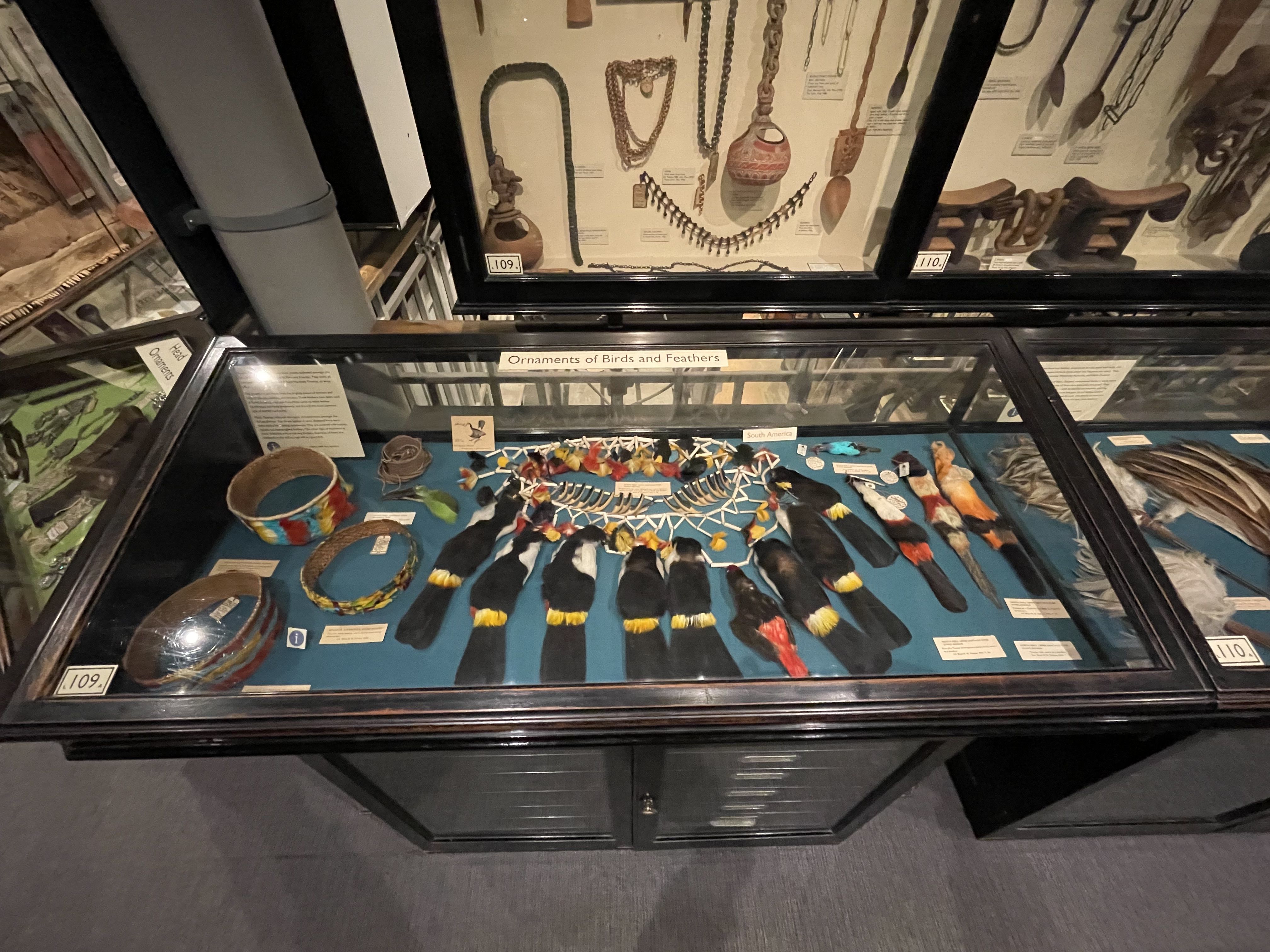
A Shuar headband tawasap
Ramphastos sp / Cracidae sp / Cotinga cayana
This brilliantly coloured headband is known as a tawasap, worn by members of several Indigenous groups in Peru and Ecuador, including the Shuar community
The tawasap is made on a complex meshwork of woven fibres, which are tied together to be able to fit around the forehead of the wearer and secured at the back with cotton cords.
The bright red and yellow feathers which decorate the outer bands of the crown are tufts of feathers from the rump of various toucan species (remember the specimen we saw in the Natural History Museum?). Each toucan only possesses a small number of these feathers, so one tawasap can require dozens of individual birds to create. Toucans (or tsukanka in Shuar) are considered hard to hunt, in part because they are considered to be especially resistant to blowgun poison. The difficulty in acquiring their feathers only contributes to the high prestige of the tawasap.
Towards the centre of the tawasap, are a second band of shiny black feathers . These are traditionally collected from large, ground dwelling birds in the Curassow family (Cracidae). They are known as mashu in Shuar.
Though you can't see it as it is currently displayed, this tawasap also has a secret - a single blue feather of a spangled cotinga (Cotinga cayana) is nestled amongst the toucan feathers. In Shuar these birds are secha, and are known for their alluring beauty. Perhaps this feather was placed secretly to give the tawasap a greater beautifying power?

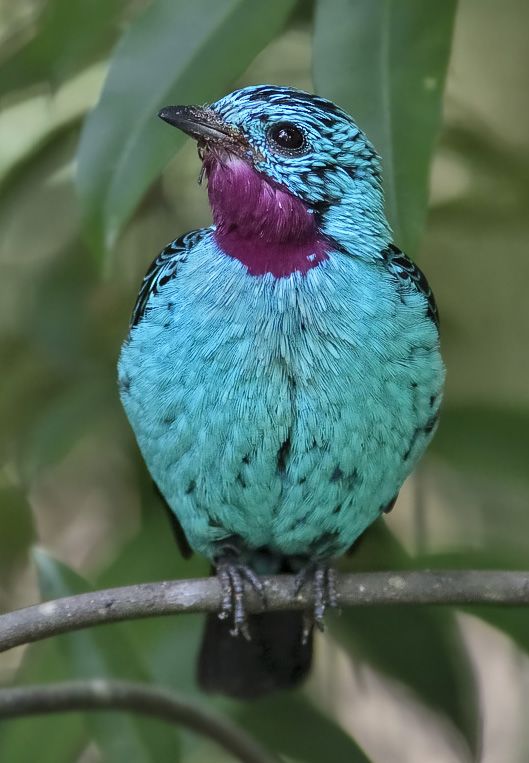
Spangled cotinga (Cotinga cayana). Image: Doug Janson
Spangled cotinga (Cotinga cayana). Image: Doug Janson
Many members of the Shuar community believe that tawasap should only be worn by men. Its use should be limited to leaders, teachers (juakmaru) and shamans (uwishins), and revered hunters in the community, those who possess the power of Arutum (the great spirit who inhabits the rainforest).
The tawasap has come to be a marker of Shuar identity and authority in the international sphere, as part of discussions of global climate change and biodiversity loss. At the 2021 United Nations Climate Change Conference (COP 26) in Glasgow for example, Tuntiak Katan, General Coordinator of the Global Alliance of Territorial Communities, spoke whilst wearing a tawasap.
His speech emphasised the urgent need for countries like the UK to meaningfully commit to supporting Indigenous peoples in the fight against climate change:
“Science is finally recognizing that indigenous populations are the best protectors of rainforests and of biodiversity. We are here to tell Glasgow, the world leaders, that the indigenous populations are here to make a pact for life because there is no more time. Don’t make political promises that you are not going to keep."
Indigenous peoples make up only 5% of the total global population but Indigenous territories sustain over 80% of the Earth’s remaining biodiversity. Despite this, Indigenous voices are not always equally invited into the spaces where responses to the threats of global biodiversity and planetary futures are formulated. Leaders like Tuntiak Katan are petitioning to change this.
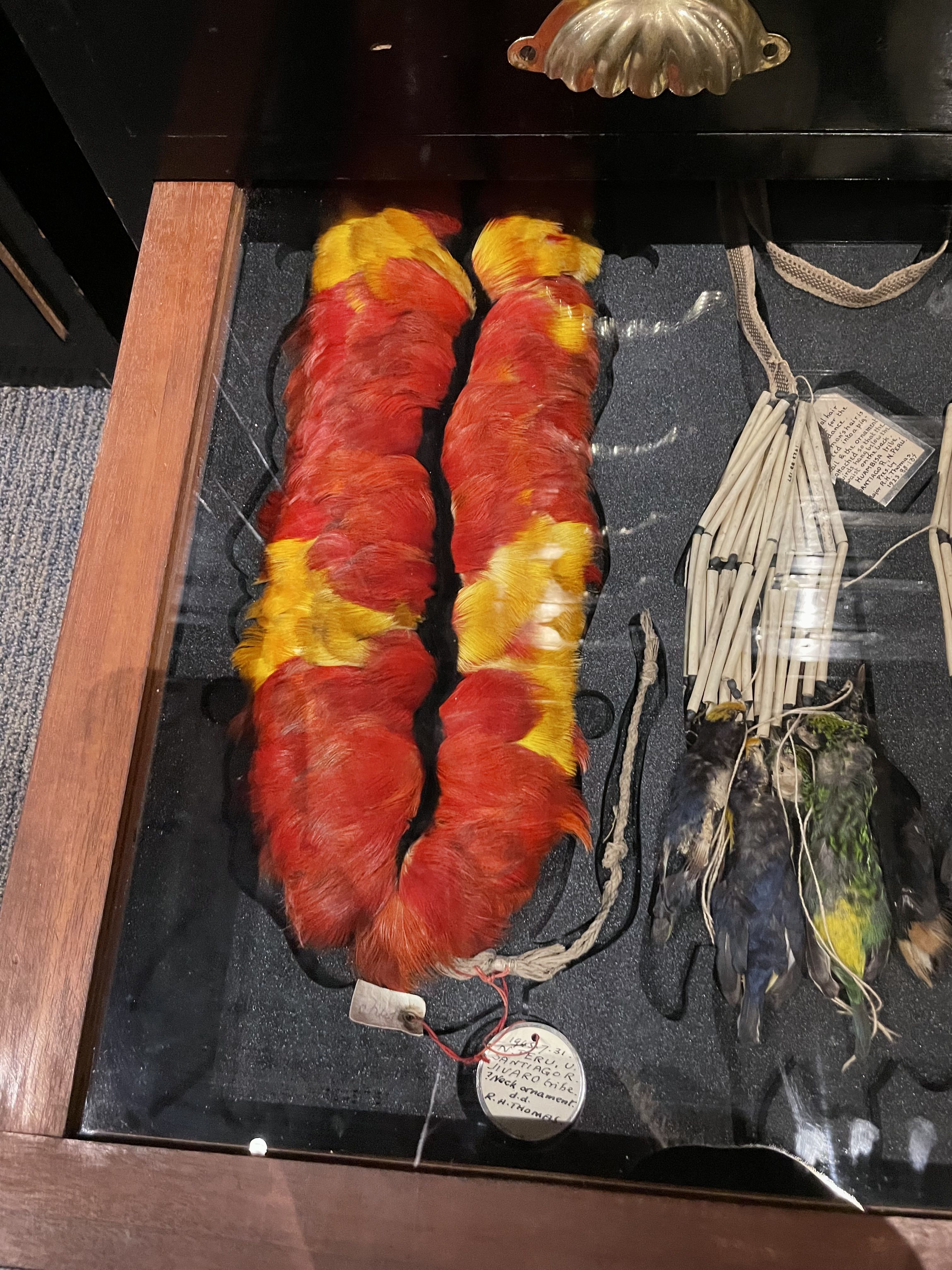
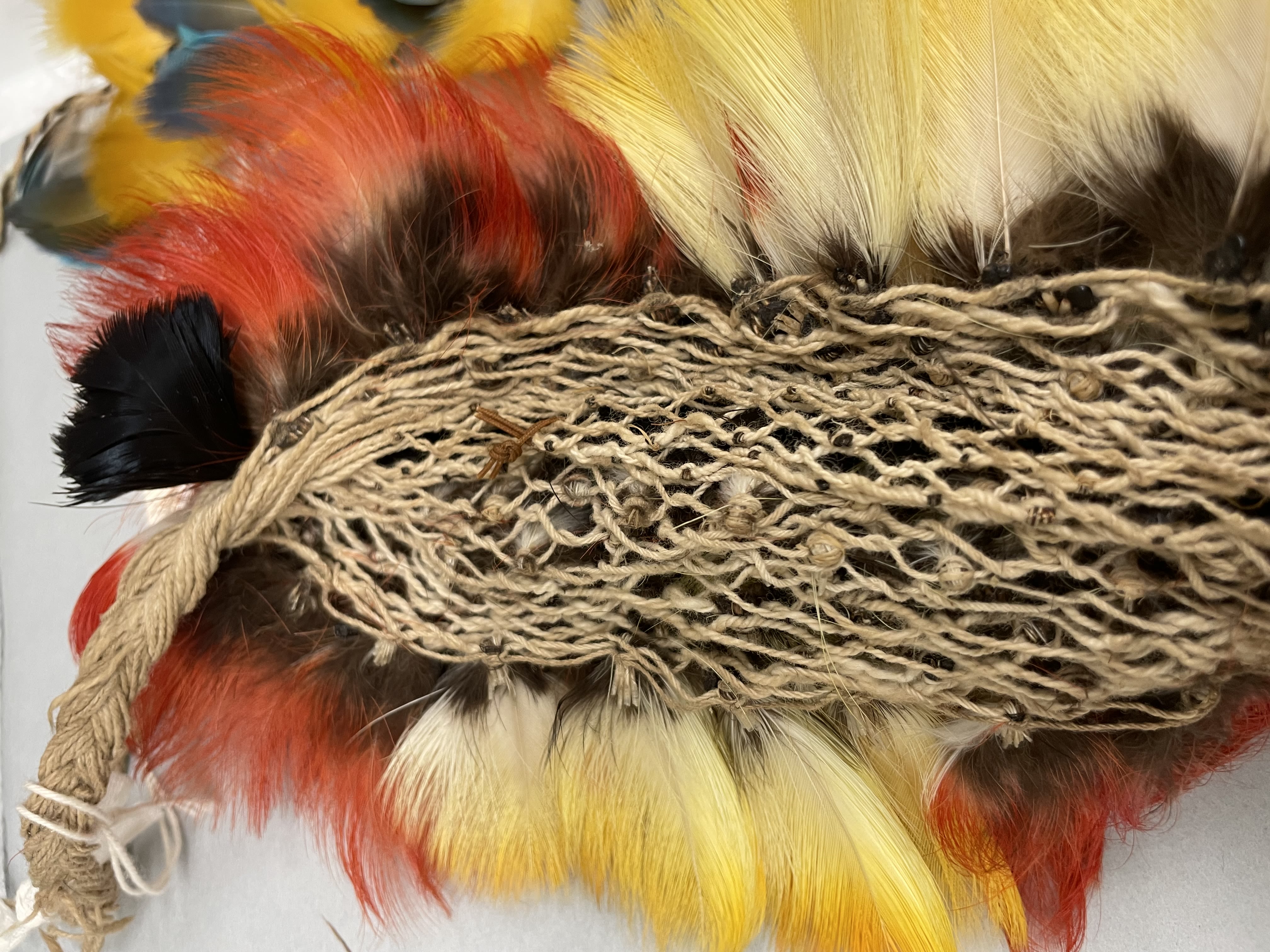
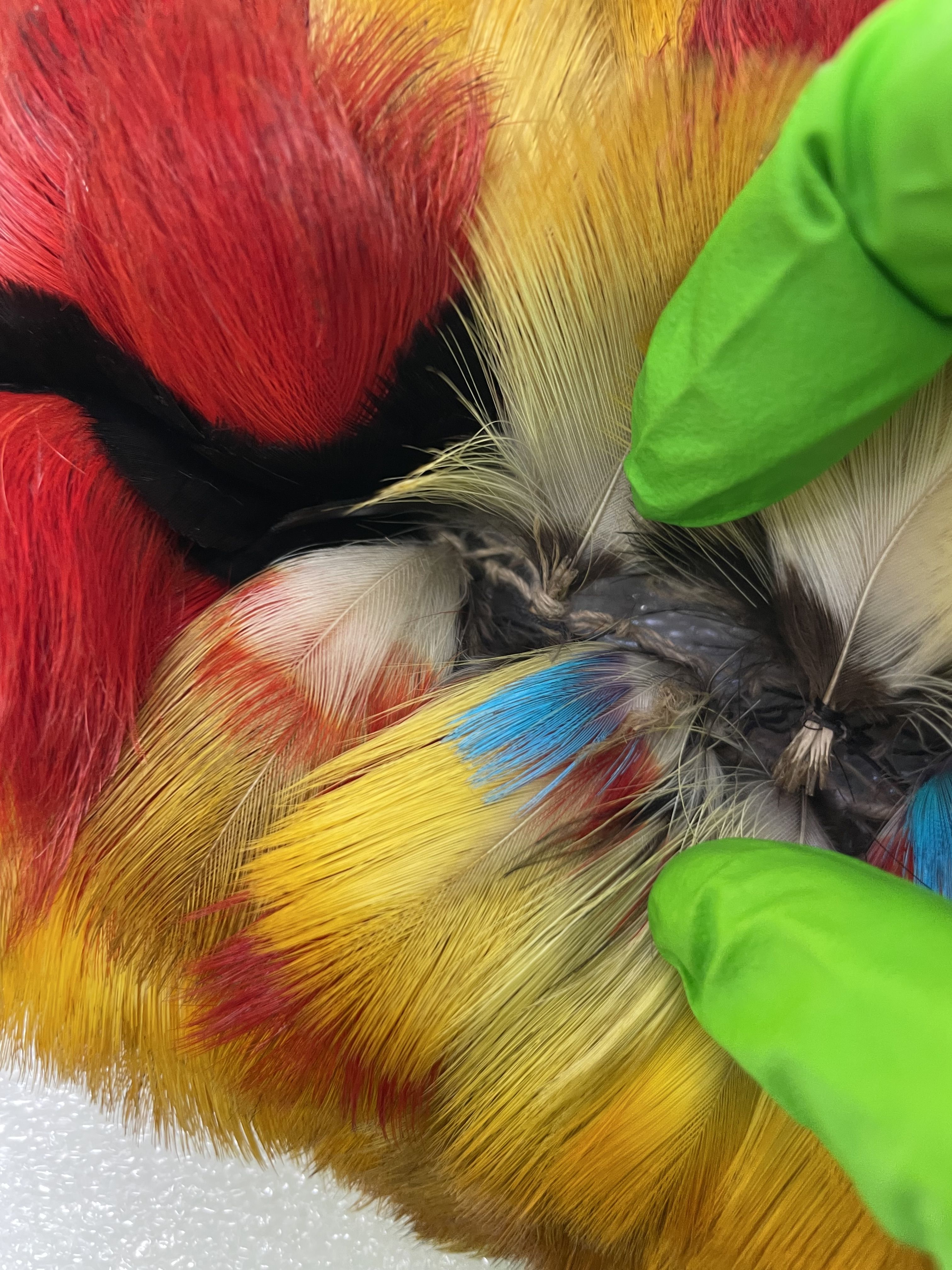
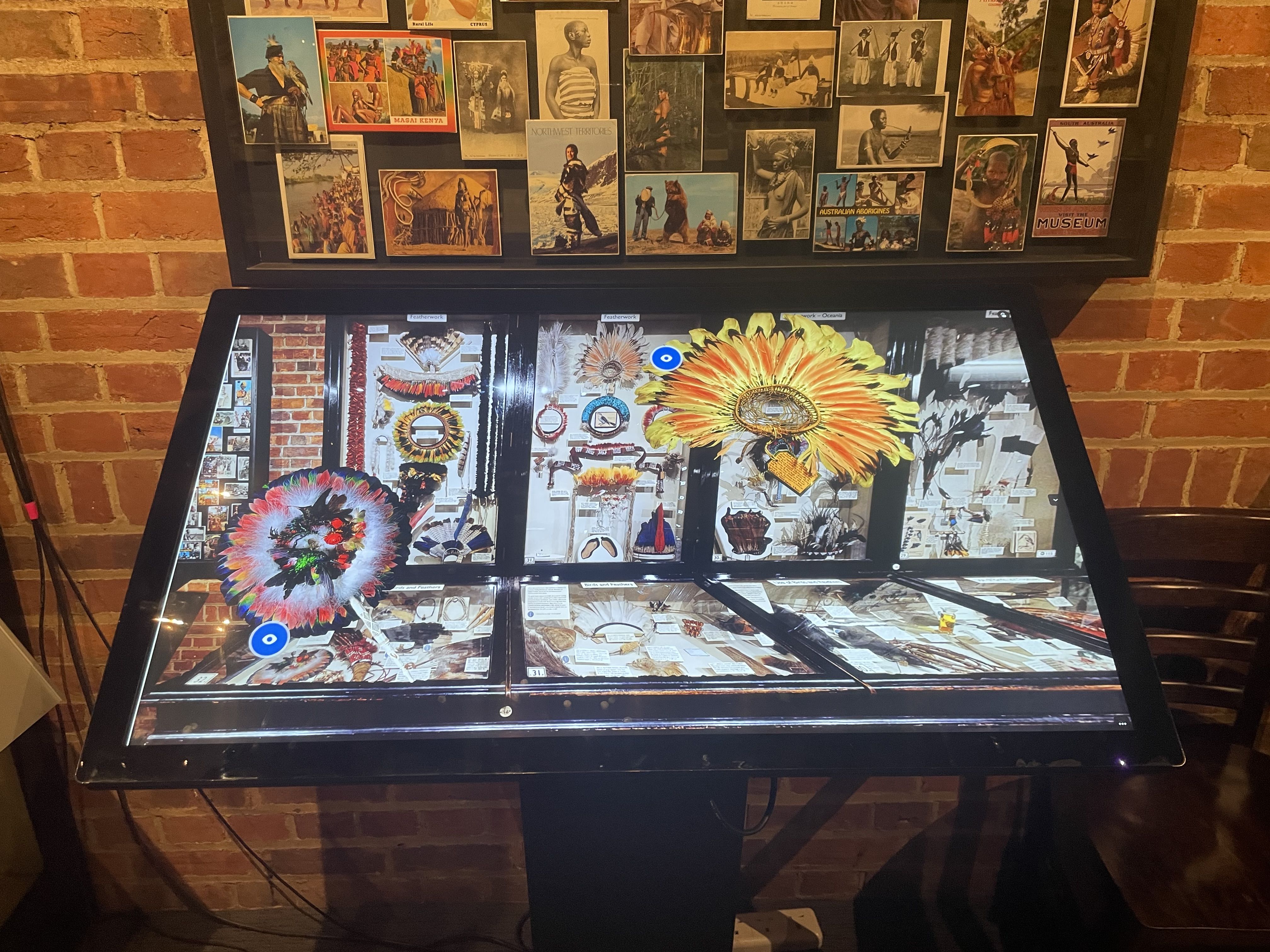
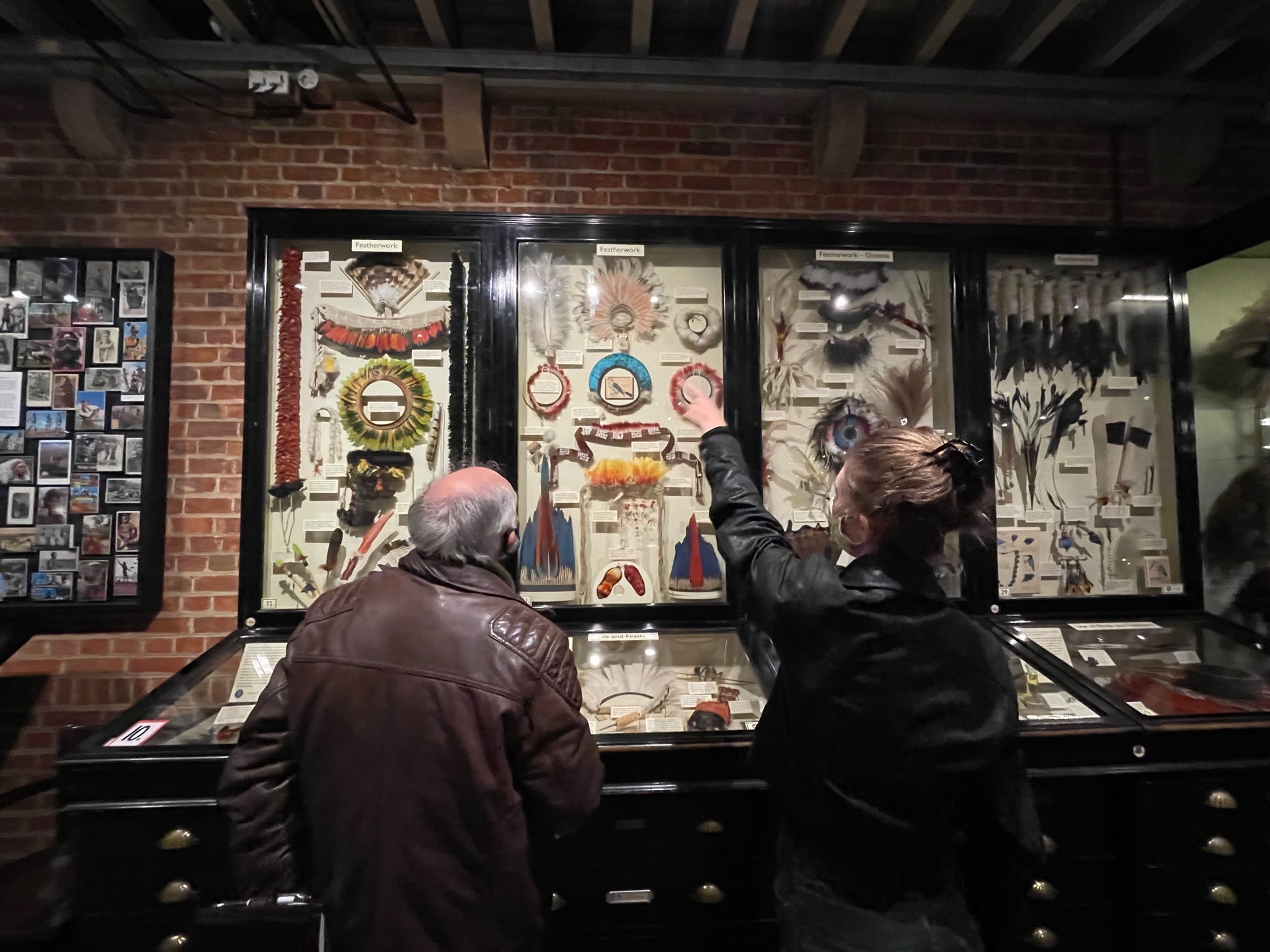
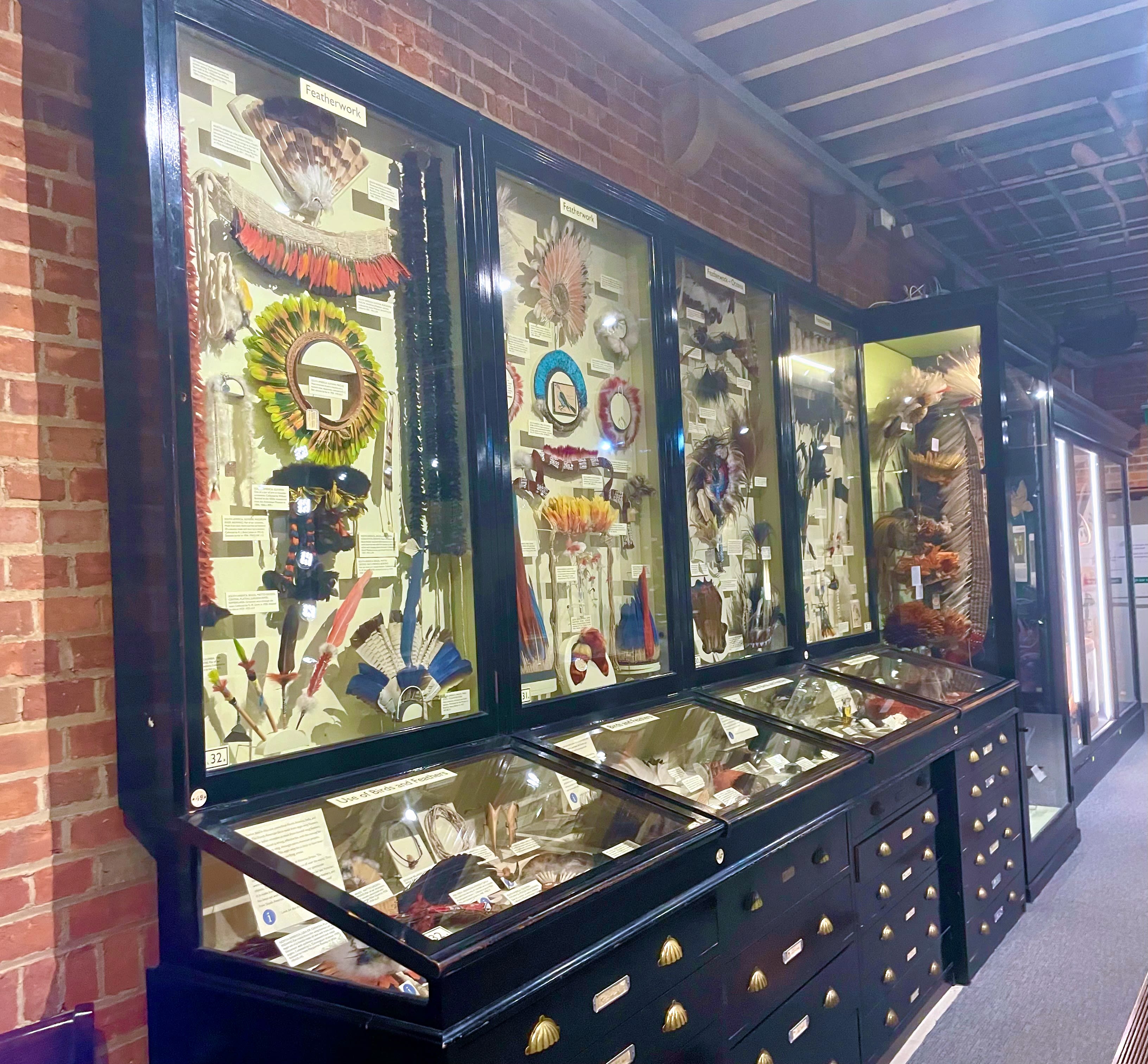
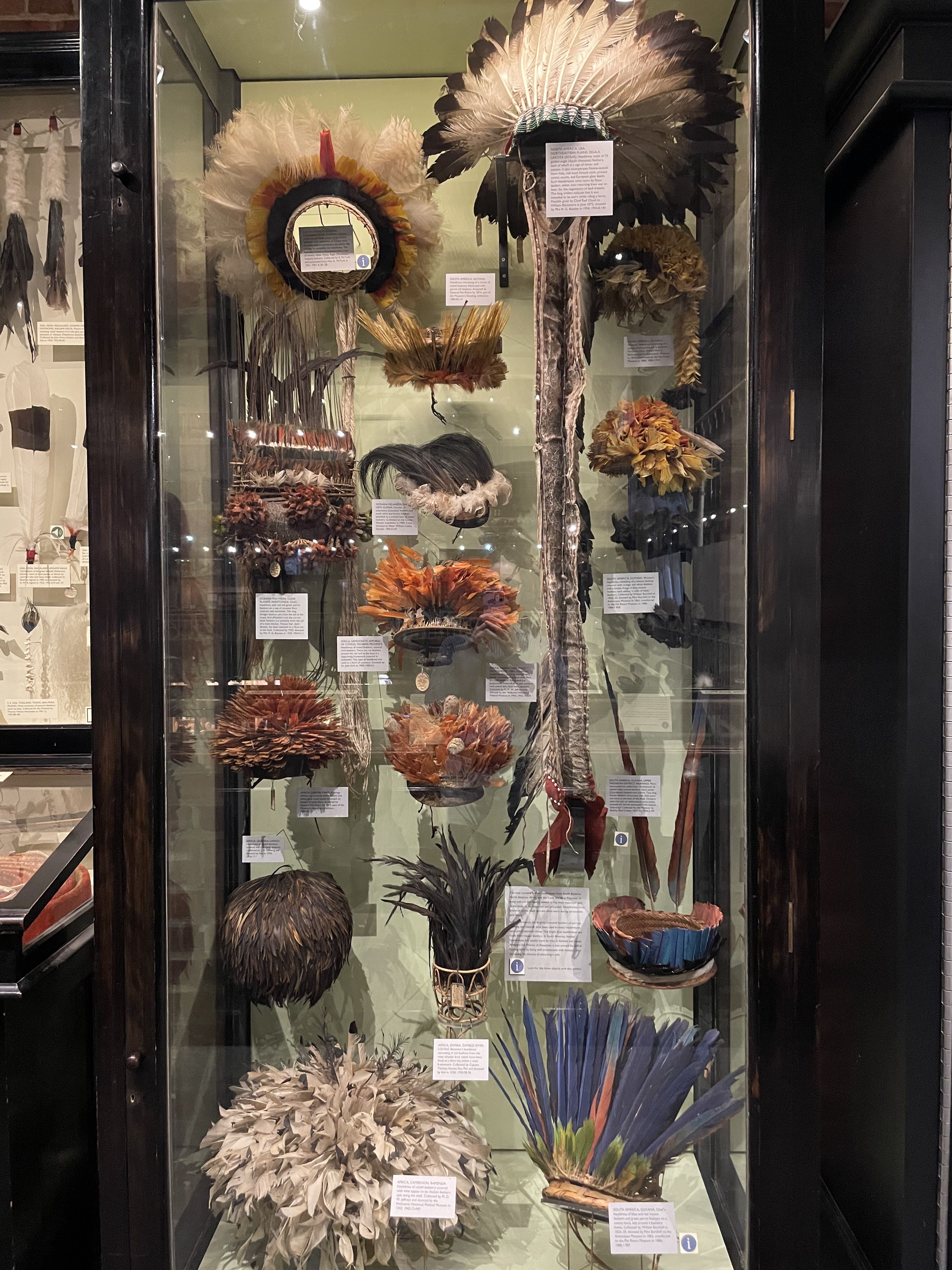
We now move along the Lower Gallery to the main Featherwork displays - four large cabinets that span most of the length of one wall of the mezzanine.

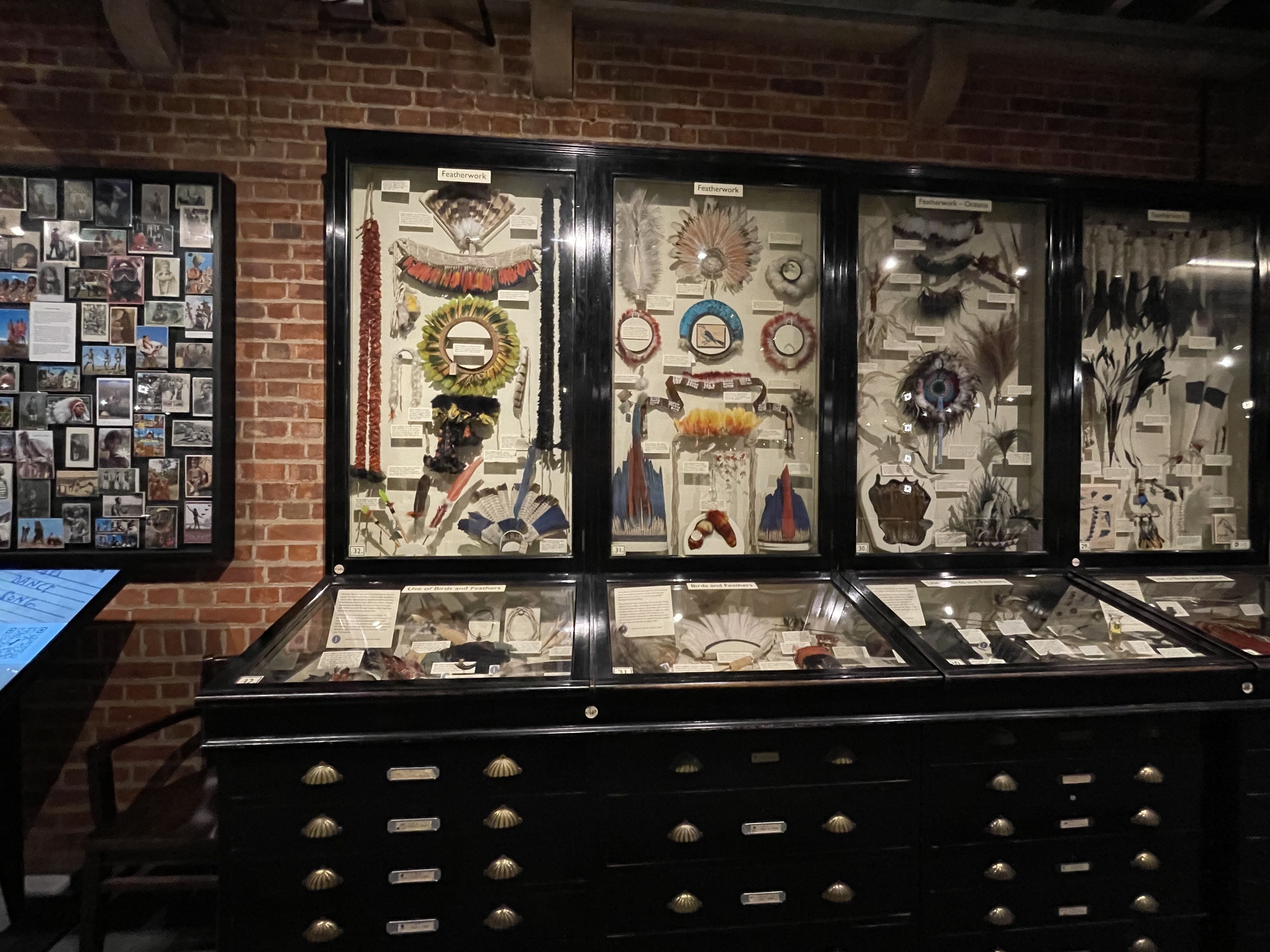
Featherwork displays, Lower Gallery Pitt Rivers Museum
Featherwork displays, Lower Gallery Pitt Rivers Museum

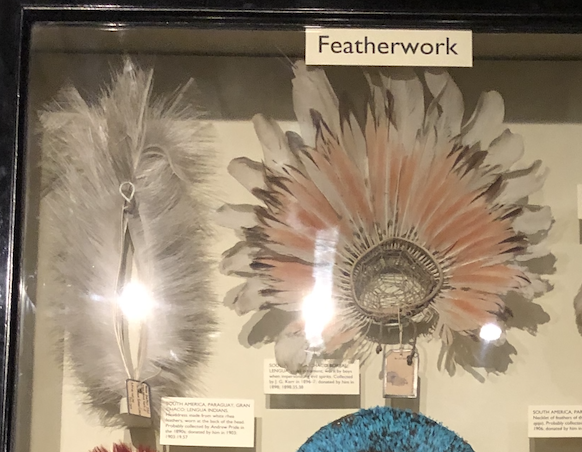
1903.19.57, a rhea feather hair ornament, and 1889.35.38, a flamingo and stork feather headdress
1903.19.57, a rhea feather hair ornament, and 1889.35.38, a flamingo and stork feather headdress

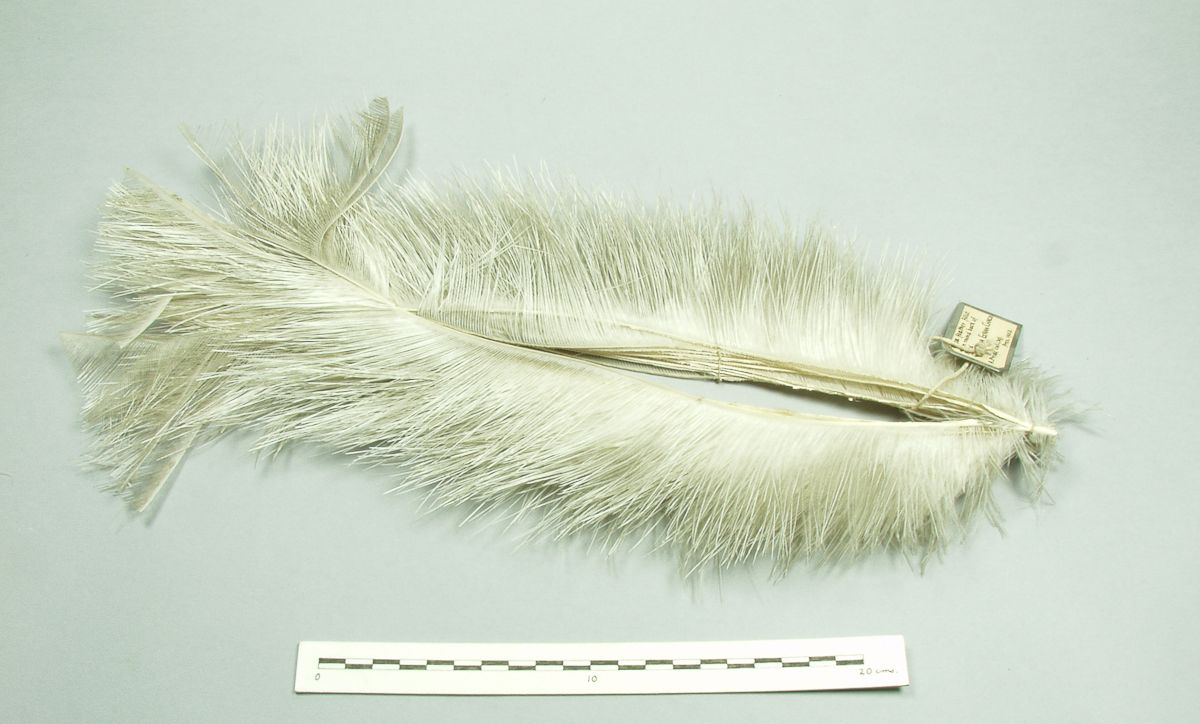
Collected by Andrew Pride in 1903
Collected by Andrew Pride in 1903

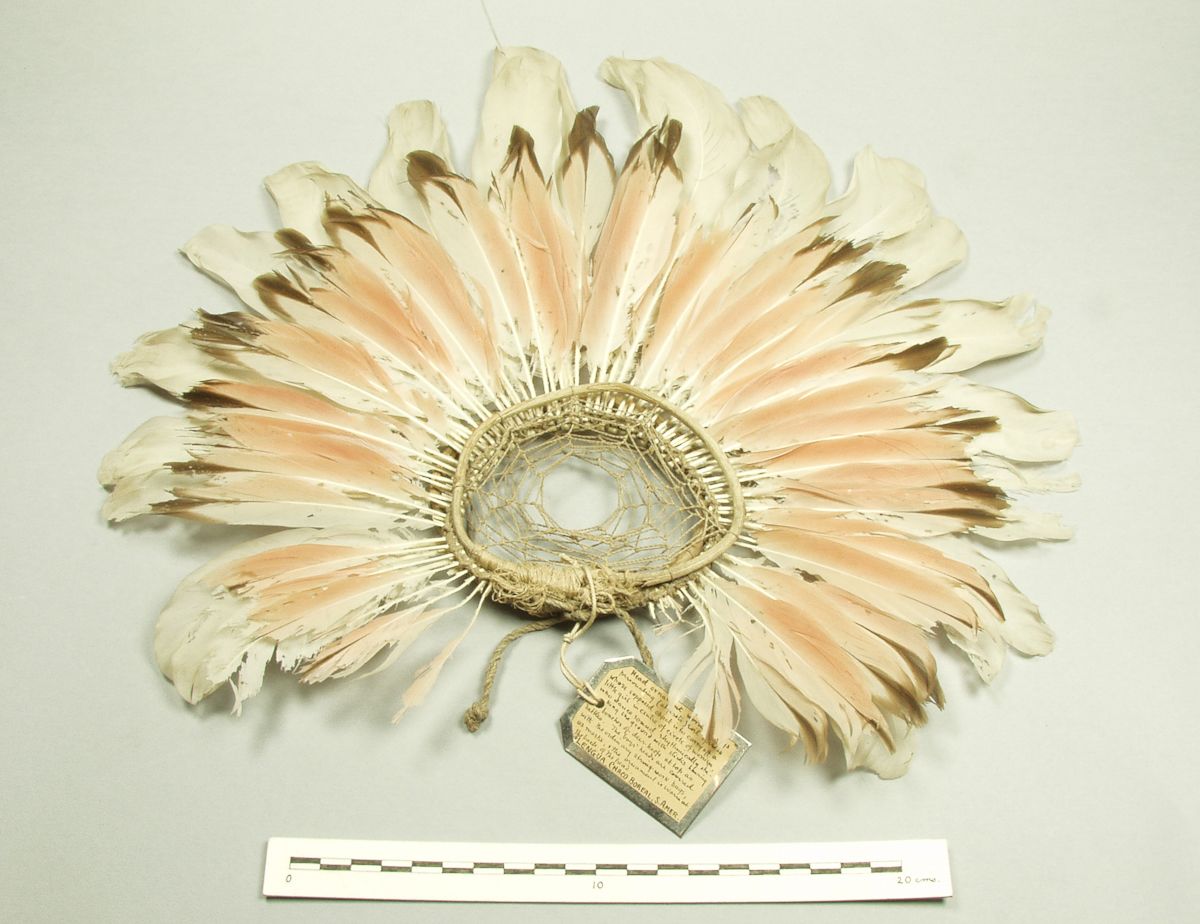
Collected by naturalist John Graham Kerr in 1896
Collected by naturalist John Graham Kerr in 1896
Enxet Headdresses
Rhea americana /Ciconia maguari / Phoenicopterus chilensis
These headdresses come from the Gran Chaco, a vast region of lowland forests and savannah grassland in South America which spans across areas of Paraguay, Bolivia, Argentina and Brazil. These particular objects both come from Paraguay.
The headdress on the left is made from feathers of the Greater rhea (Rhea americana), South America's largest bird, while the headdress on the right is made from the feathers of wetland birds: Magauri storks (Ciconia maguari) and Chilean flamingos (Phoenicopterus chilensis).

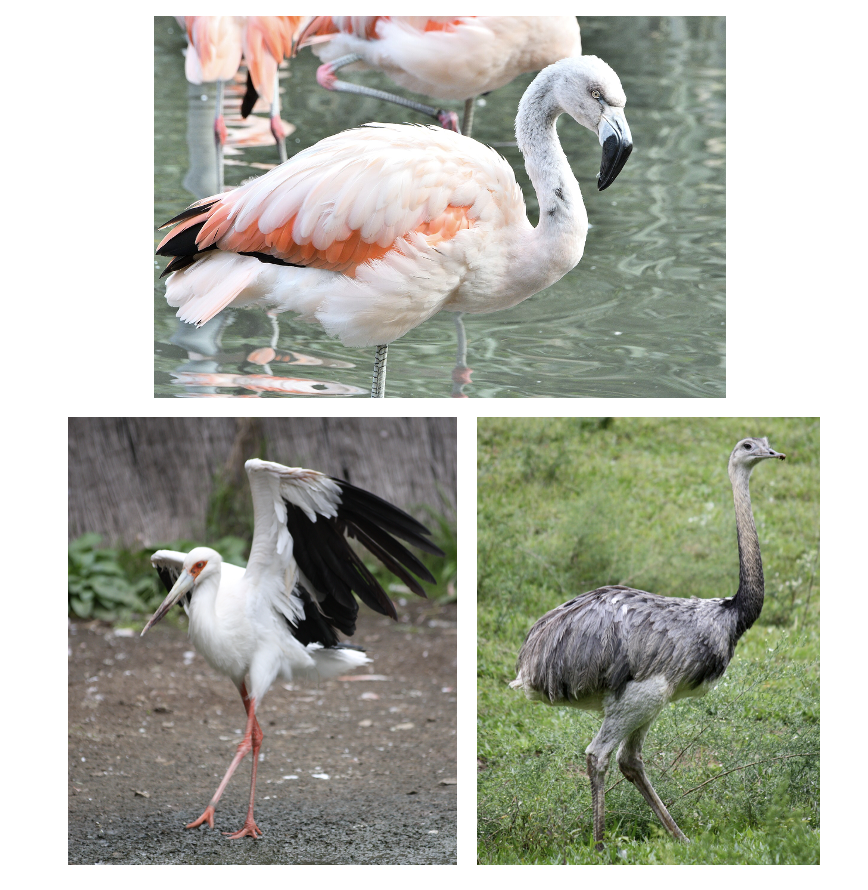
Chilean flamingo, Greater rhea and Maguari stork
Chilean flamingo, Greater rhea and Maguari stork
Feather headdresses like these were worn by members of the Enxet Sur, one of many Indigenous communities in the Paraguayan Chaco. They would be worn on the head as part of the yanmana, a girl's initiation ceremony which involved complex dance formations. Rhea feathers would be worn by the female initiate, together with deer foot rattles and necklaces made from shells.

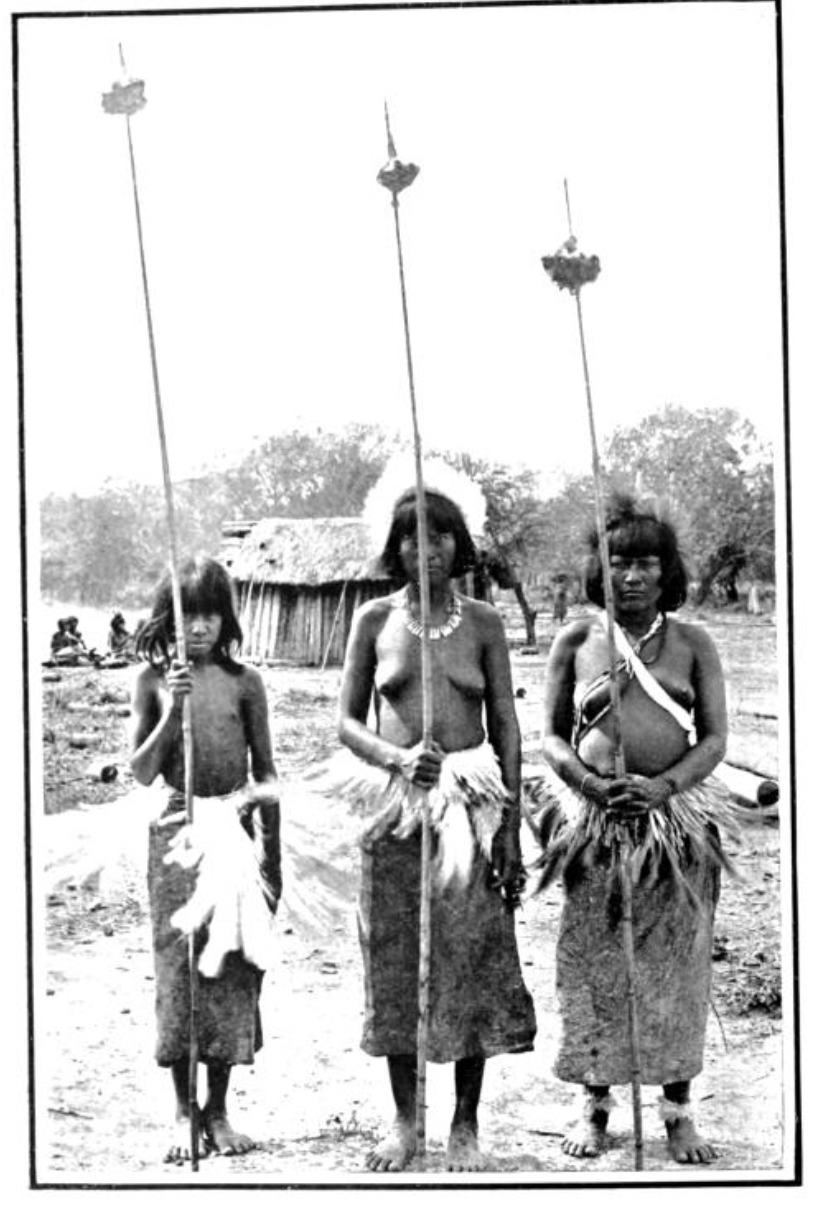
Women dressed for the yanmana. Photo by Andrew Pride. Pitt Rivers Museum
Women dressed for the yanmana. Photo by Andrew Pride. Pitt Rivers Museum
The dance of the yanmana required the girl to repeatedly fend off attacks from spirits known as salowak. Young men would wear flamingo feather headdresses, rhea feather skirts and woven masks over their heads to impersonate the salowak, emerging from the forest shouting and running at the women, before being pushed back by older women surrounding the initiate. This dance would be repeated for hours into the night, amidst feasting and celebration.
If you look closely at the labels for these headdresses, you can see the term "Lengua" is used. This is a derogatory colonial name used to refer to the Enxet by colonial settlers in Paraguay in the 19th century. Work is being undertaken to address the problematic terms used within the labels in the museum, but many of them are still present. You can read more about the Labelling Matter project here.
Many of the Paraguayan objects were collected by members of the South American Missionary Society (SAMS). The missionaries entered the Chaco in the late 19th century with the goals of evangelising Indigenous populations and converting the Chaco into an industrially profitable landscape. The missionaries would sometimes wear featherworks themselves as costumes during "Missionary Exhibitions" once they returned to Britain. These were often racist caricatures of Enxet peoples.

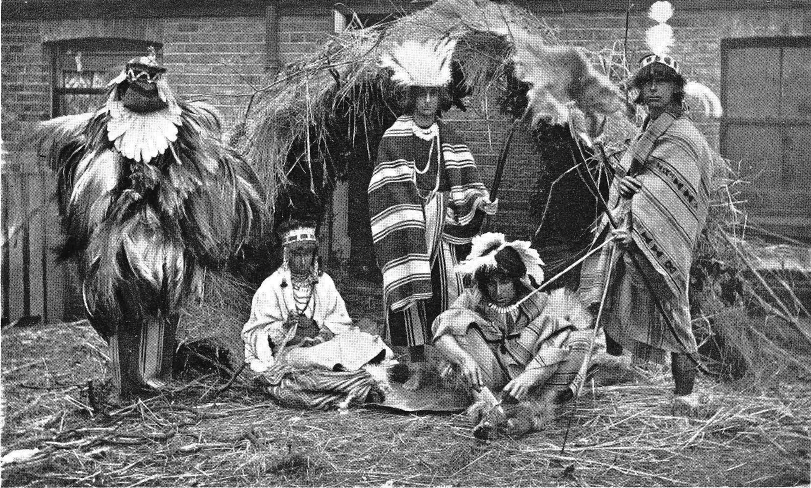
Missionaries dressed in Enxet featherworks during a Missionary Exhibition in London
Missionaries dressed in Enxet featherworks during a Missionary Exhibition in London
The influence of this work is still evident today, and much of the Chaco has now been transformed through cattle-ranching and monocrop agriculture, processes which were initiated by the missionary projects. Birds like the rhea are threatened by these developments, and the Enxet can no longer hunt or create featherworks in the same way.
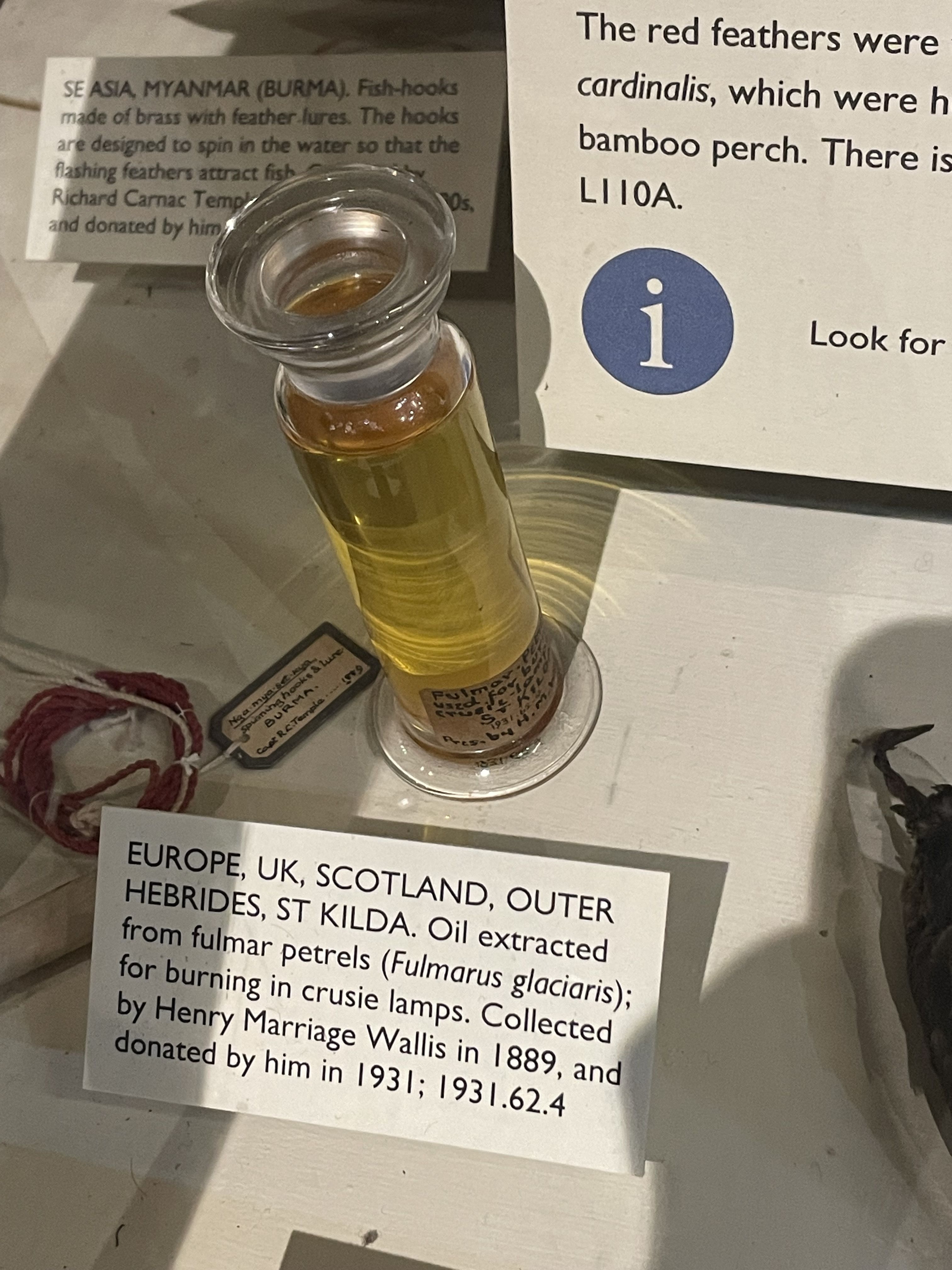
1931.62.1 Jar of fulmar oil for burning in lamps. Collected by H.M Wallis
1931.62.1 Jar of fulmar oil for burning in lamps. Collected by H.M Wallis
Fulmar Lamp
Fulmaris glaciaris
This small glass vial of yellow oil was collected from the island of St Kilda in the Outer Hebrides by a man called Henry Wallis in 1889. While on first look, the relationship between this object and birds may not be very clear, the oil itself actually comes from the stomach of seabird called the Northern Fulmar.


St. Kilda from the sea. Photo credit: Rob Farrow
St. Kilda from the sea. Photo credit: Rob Farrow
Northern Fulmars (Fulmaris glaciaris) are found in the northern hemisphere around the North Pacific and Atlantic oceans. They are one of our most common seabirds in northern Britain and are found year round. Though gull-like in appearance, they are actually more closely related to albatrosses. They nest on the ledges of cliffs and feed on zooplankton and small fish. They can be opportunistic feeders and will also eat discarded fish, making them common companions of fishing vessels.

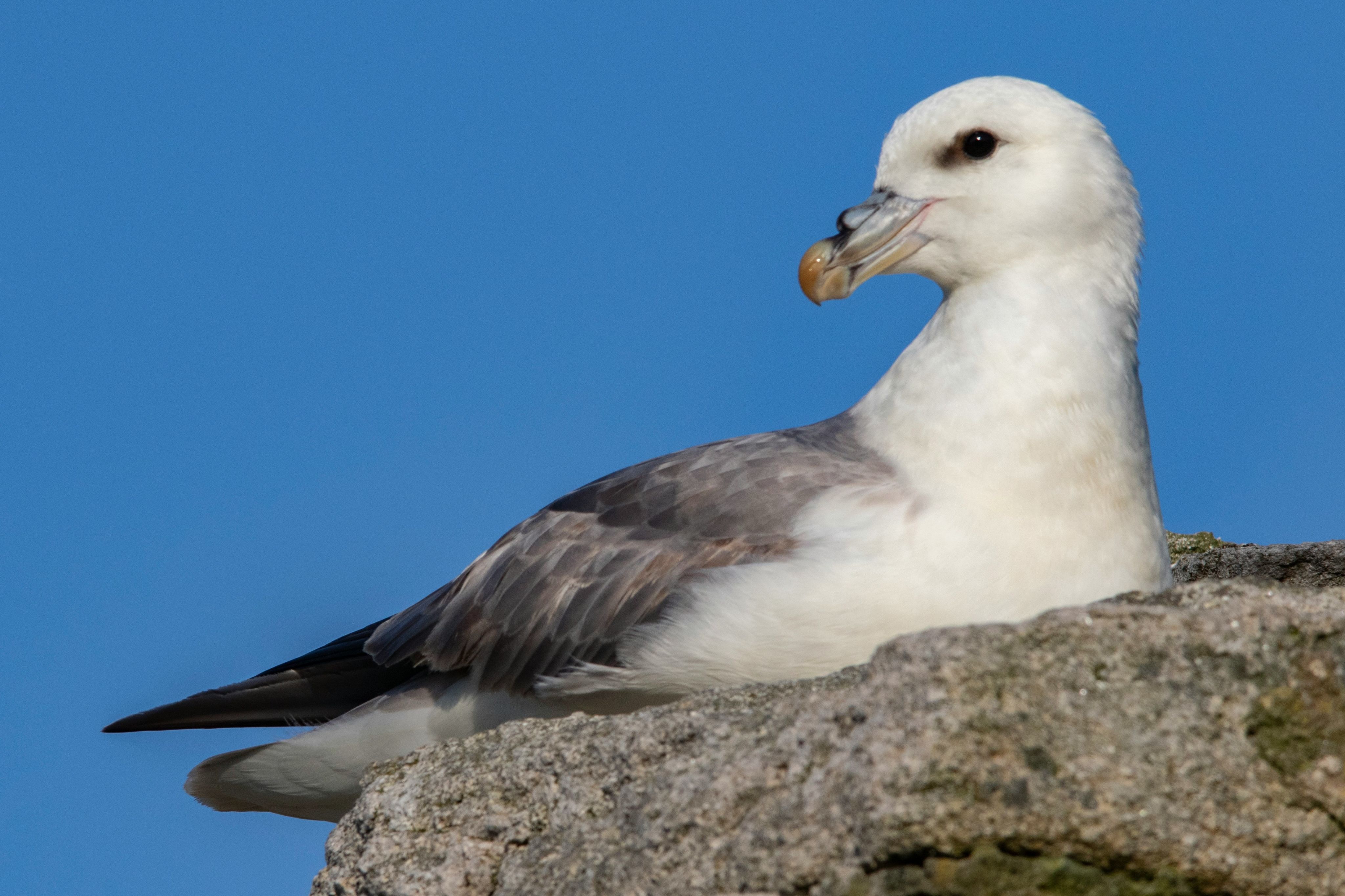
Northern Fulmar. Photo by Duncan McNab
Northern Fulmar. Photo by Duncan McNab
The oil shown in this lamp is the result of a pretty distinctive bodily feature of fulmars: they can eject a foul-smelling oil from their fore-guts and out of their mouths as a defence against predators. This behaviour is practiced by both adults and chicks. You can imagine as a predatory bird like a peregrine falcon trying to eat a fulmar chick, you would be quite put off if your feathers were suddenly covered in stinky stomach fluid! The word fulmar actually refers to this, being a mix of two Old Norse words: fúll (“foul”) and már (“gull”).
For the inhabitants of St Kilda, seabirds were a staple part of their diet and livelihood in the 19th century. All other work on the island would stop during the fulmar hunting season. All parts of the bird would be used, the feathers reserved for sale and for bedding, the meat either eaten fresh or preserved with salt. The oil in particular was a mainstay of the St Kildan’s economy, and would be used as a fuel for lamps, the oil poured into the dried stomach of a gannet and used as a candle – probably the purpose of this oil in the vial.

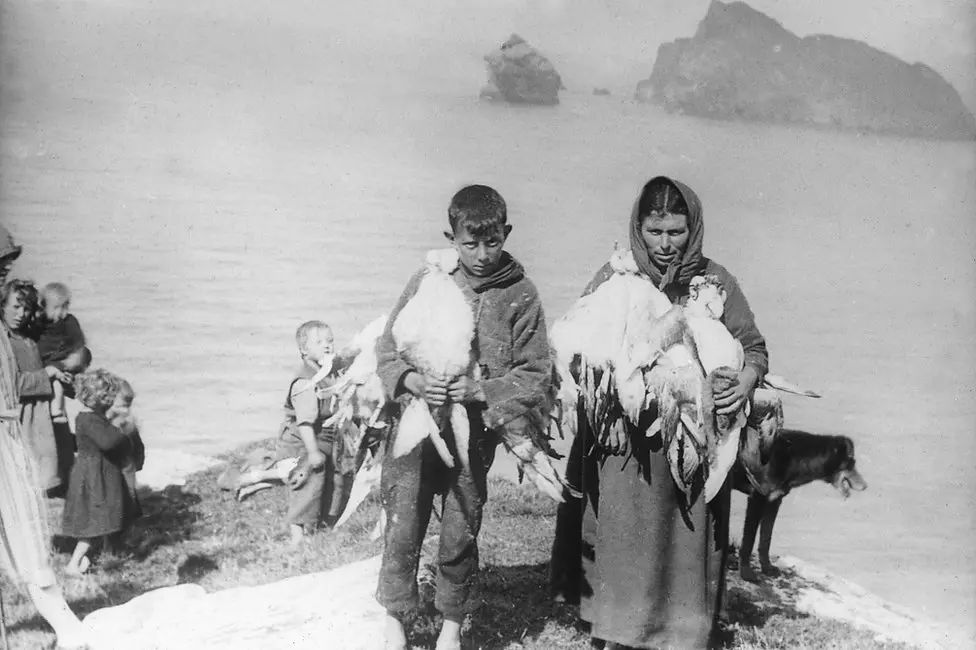
Hunted fulmar on St Kilda in the 1880s. Image: National Trust for Scotland
Hunted fulmar on St Kilda in the 1880s. Image: National Trust for Scotland


Hunting fulmar on the cliffs of St Kilda, 1880s. Source: National Trust for Scotland
Hunting fulmar on the cliffs of St Kilda, 1880s. Source: National Trust for Scotland
From the late 19th century onwards, fulmars expanded their range beyond St Kilda, and their numbers increased rapidly in the British Isles for most of the 20th century. One of the reasons for this expansion was probably the due to a decrease in hunting as the population on St Kilda diminished, as people started to rely more on imports. In 1930 the last inhabitants of St Kilda were evacuated and the period of fulmar hunting came to an end.
Up until about 15 years ago, we saw a considerable increase in the fulmar population in Britain, but now that trend seems to be changing again. On St Kilda, a study last year showed that there are more than 45,000 fewer fulmars on the island than there were 24 years ago.
The stomachs of the fulmars are telling worrying stories. They are being used as biomonitors for assessing marine plastic debris. Northern fulmars are particularly suitable as biomonitors of trends in plastic pollution because, like many petrels, they forage exclusively at sea, have vast migratory ranges and display surface feeding habits that makes them prone to ingest plastic. New studies of Northern Fulmar between 2008-2013 worryingly showed the presence of micropastics in 89.5% of birds.

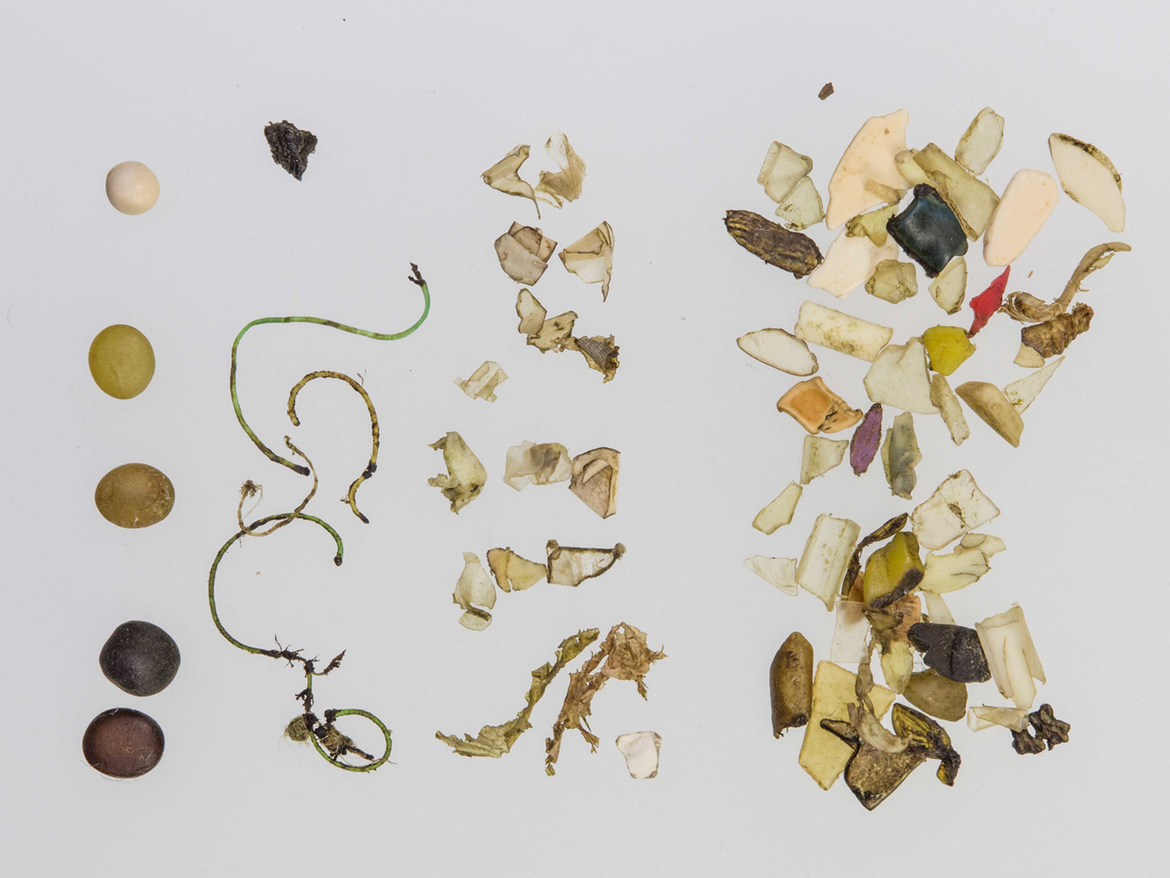
Plastics found in the stomachs of Fulmars by Susanne Kühn and Jan Andries van Franeker. © J.A. van Franeker
Plastics found in the stomachs of Fulmars by Susanne Kühn and Jan Andries van Franeker. © J.A. van Franeker
A Mundurucu Headdress
Amazona sp / Cracidae sp / Ara ararauna
This headdress is one of my favourites in the Featherwork displays here in the Pitt Rivers Museum. While the label currently describes it as originating in Guyana, the research I've been undertaking on its history suggests it more likely derives from the Mundurucu community, an Indigenous group whose ancestral territories are found in the Upper Rio Tapajos area of northern Brazil.
As you can see, it is a pretty spectacular object, composed of several kinds of feather. The black feathers are from curassows, the same kind of bird that we have already seen in the Shuar tawasap. The long blue feathers are from the tail of a blue-and-yellow macaw (Ara ararauna) and the yellow feathers are probably from a species of Amazon parrot (Amazona sp.).

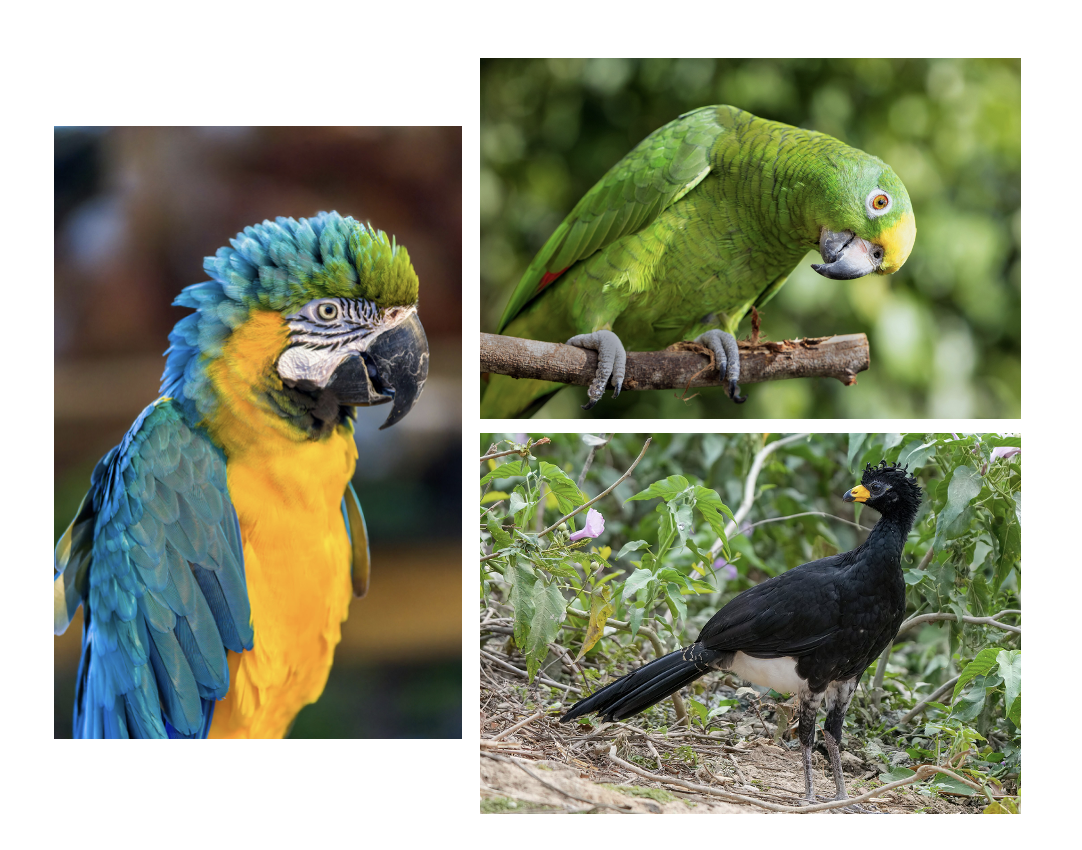
Blue-and-yellow macaw, mealy amazon, and bare-faced curassow.
Blue-and-yellow macaw, mealy amazon, and bare-faced curassow.
The yellow feathers are a particularly unusual feature, because these bright yellow-orange feathers are not the natural colour of Amazon parrots, who are usually green. Instead, their colour has been changed through a remarkable process called “tapirage”.
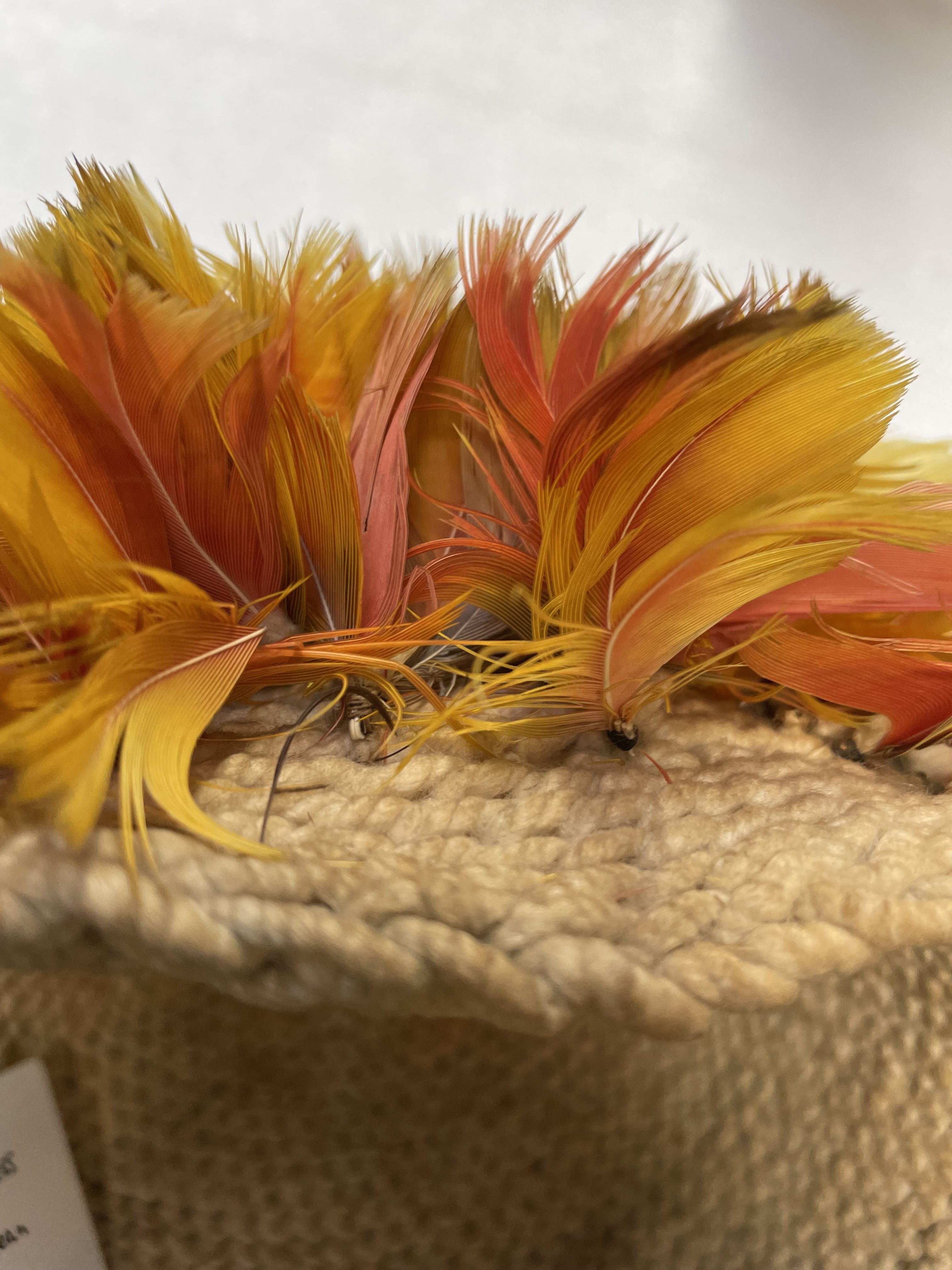
tapirage feathers in 1886.1.908
tapirage feathers in 1886.1.908
Tapirage is a technique which was practiced by Indigenous communities across South America for hundreds of years. It involves plucking the feathers from live parrots, and then feeding the parrots a special diet and rubbing the plucked areas of the parrots skin with tinctures made from plants like annatto (Bixa orellana) or from the skin secretions of frogs. The result is that feathers which would previously have been green will grow back as yellow or orange.

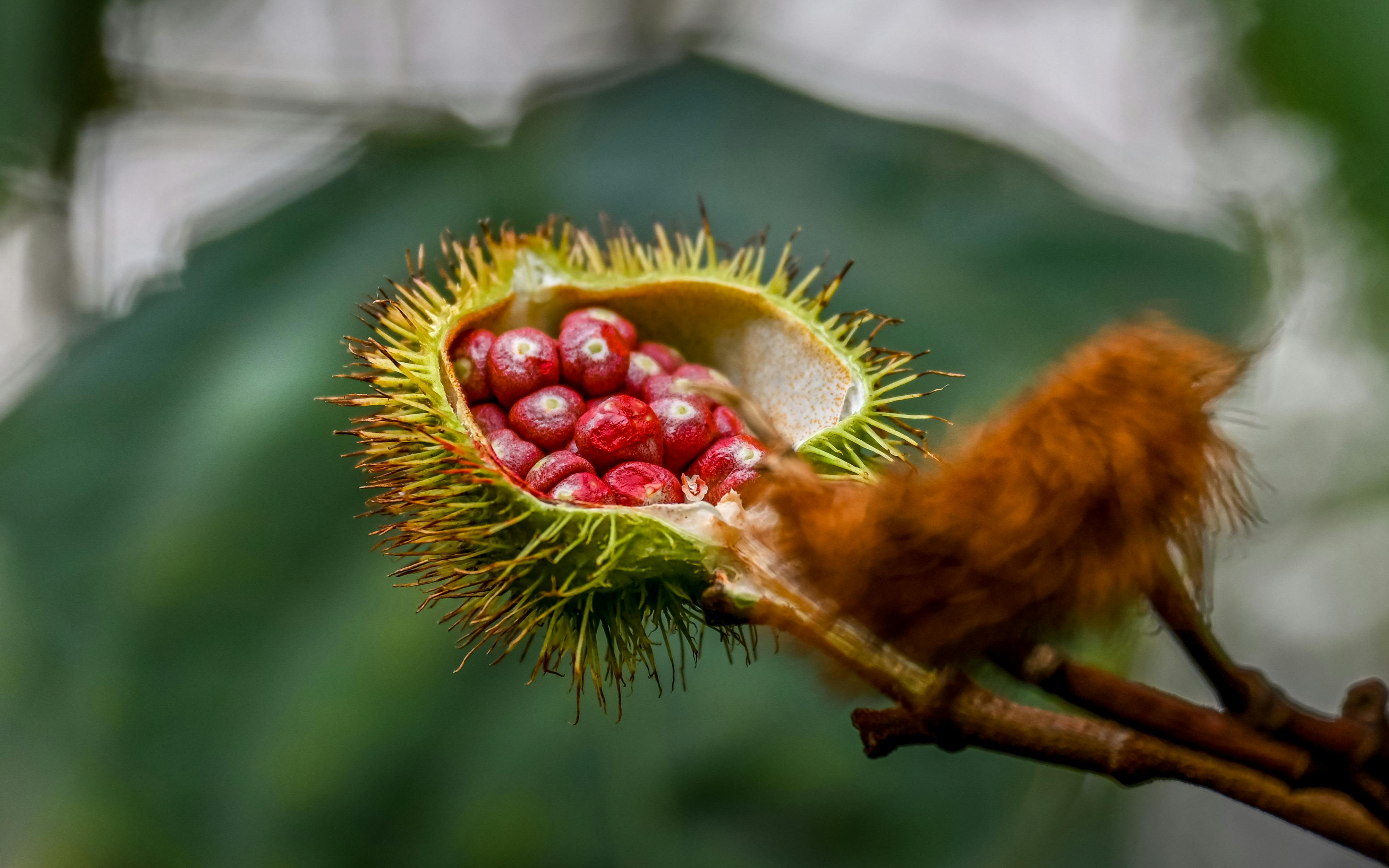
Annatto (Bixa orellana). The seeds can be crushed to make tinctures, or used for red dye and body paint. Photo by Lorna Pauli
Annatto (Bixa orellana). The seeds can be crushed to make tinctures, or used for red dye and body paint. Photo by Lorna Pauli
The kind of frogs used were probably in the Dendrobatidae family, known commonly as dart frogs. Their skin secretions contain powerful toxins, and are famously used by South American peoples to make poisoned arrows or blow darts. We still don't know exactly how these substances would have affected the feather colour, or indeed the health of the parrots who were being rubbed with them - we can imagine it might have made the parrots quite unwell!
The Latin name of one species of dart frog actually gives us a clue to its link to tapirage. In 1757, Cuvier described a small, brightly coloured yellow and blue frog found in the Guianas and Northern Brazil as Dendrobates tinctorius. The second part is a direct reference to its use in the tapirage process, "tinctorius" meaning "used to dye or change colour". The Linnean taxonomic system used by Western science is actually often closely entangled with and indebted to Indigenous knowledge and practices.

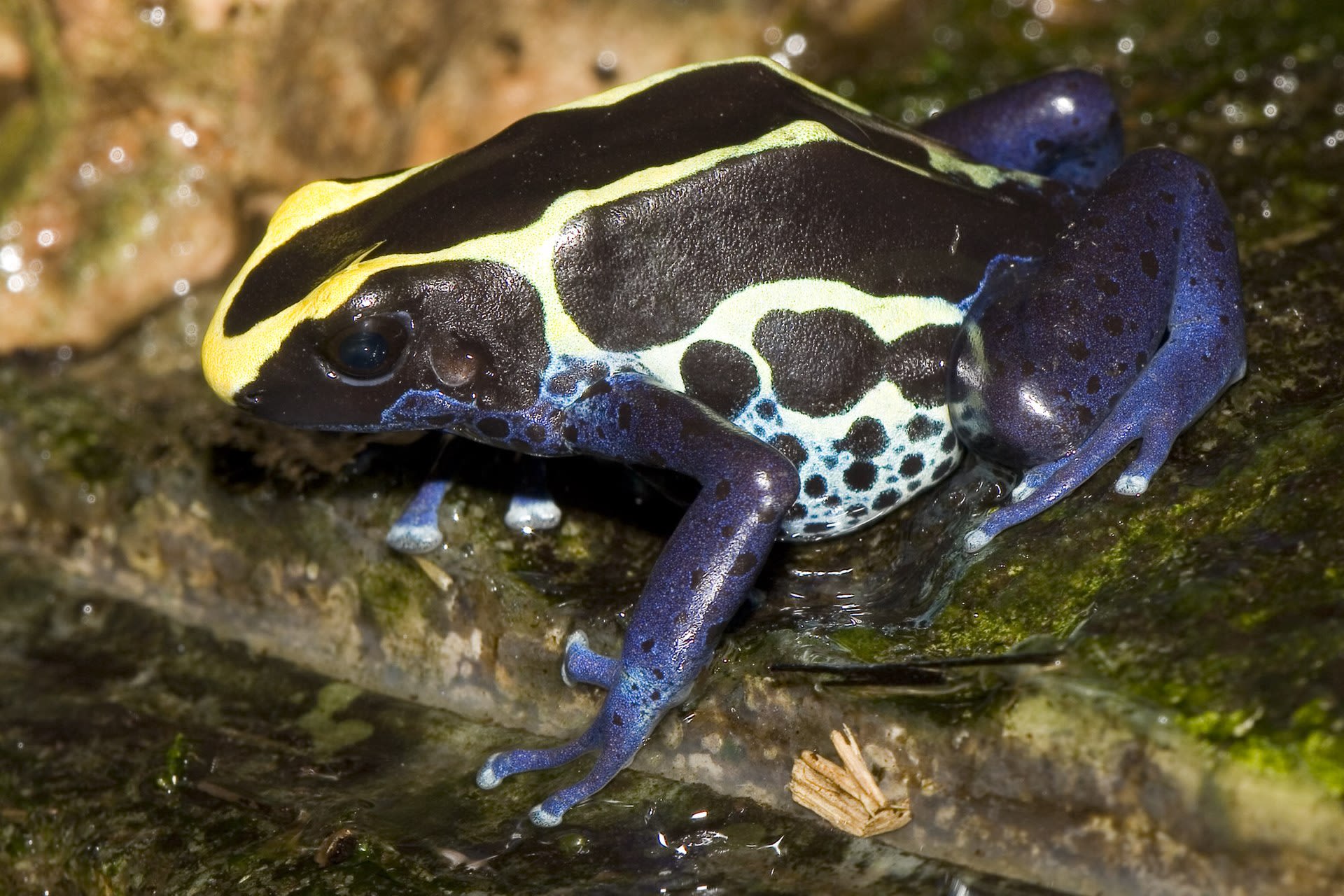
The dyeing poison dart frog or Dendrobates tinctorius
The dyeing poison dart frog or Dendrobates tinctorius
Returning to the yellow feathers, a key question is: why go to all this trouble? As you can see from other objects in the displays, other naturally yellow feathers are available in the Amazon. If we turn to the Mundurucu myth about how the birds got their colours, we can get a sense of why tapirage might be so important:
The birds painted themselves with the red blood, the blue fluid from the gallbladder, and the yellow fat. The toucan smeared blue all around its eyes, and yellow on the end of its tail, and a band of yellow across its breast. It also put a dab of blood on its tail. The woodpecker painted its head red; the pipira daubed itself all over with blue.
Transformation is a central theme in many South American Indigenous cosmologies. The birds in this myth purposefully transform their appearance by anointing themselves with different bodily substances. Perhaps this is also why tapirage feathers were valued by the Mundurucu - not because they were yellow, but because the feathers were transformed from their original appearance. This transformative power could then have been transferred to whoever wore the headdress.
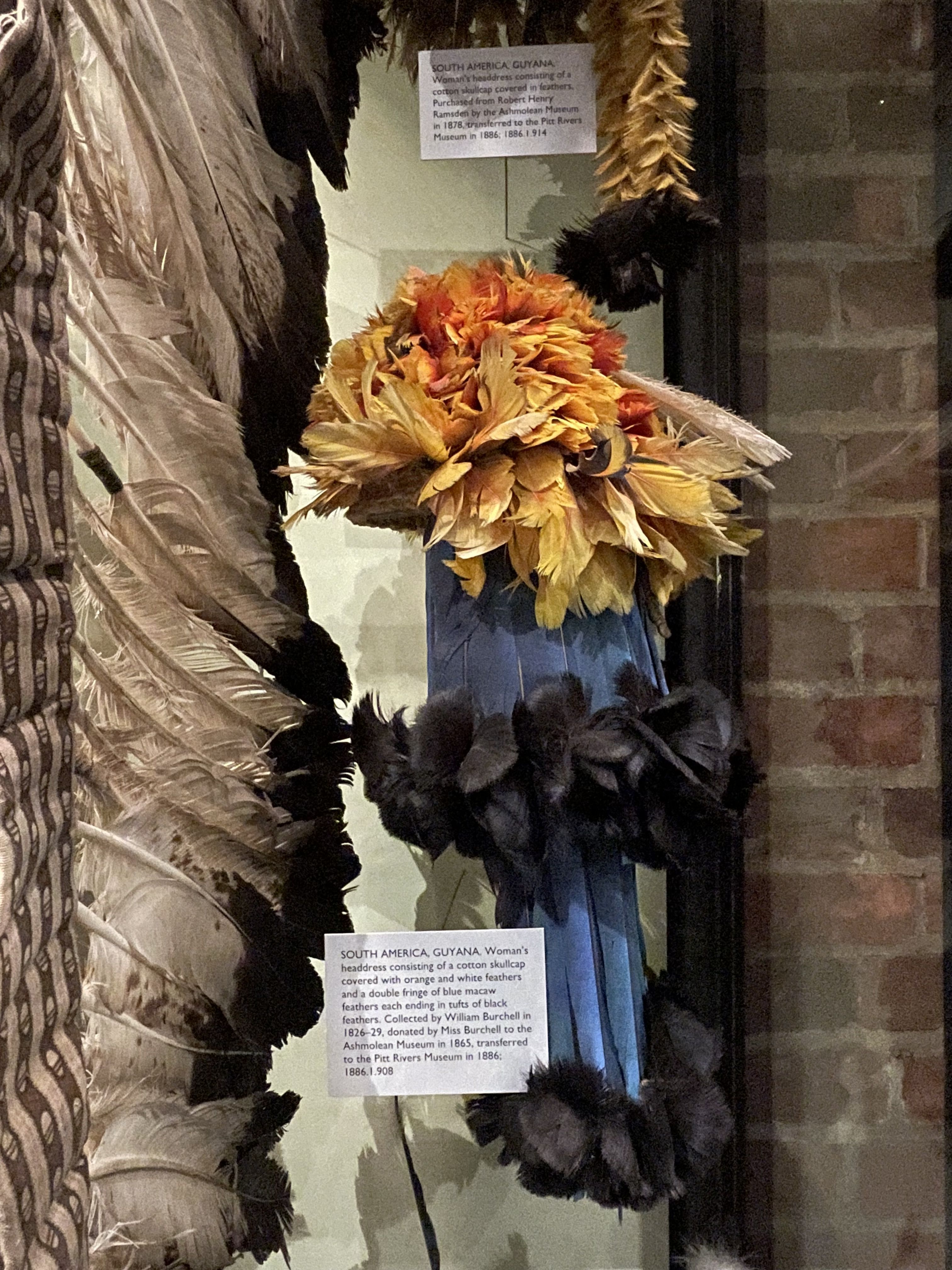
1886.1.908: Headdress collected by Willian John Burchell, probably in Brazil c1825
1886.1.908: Headdress collected by Willian John Burchell, probably in Brazil c1825
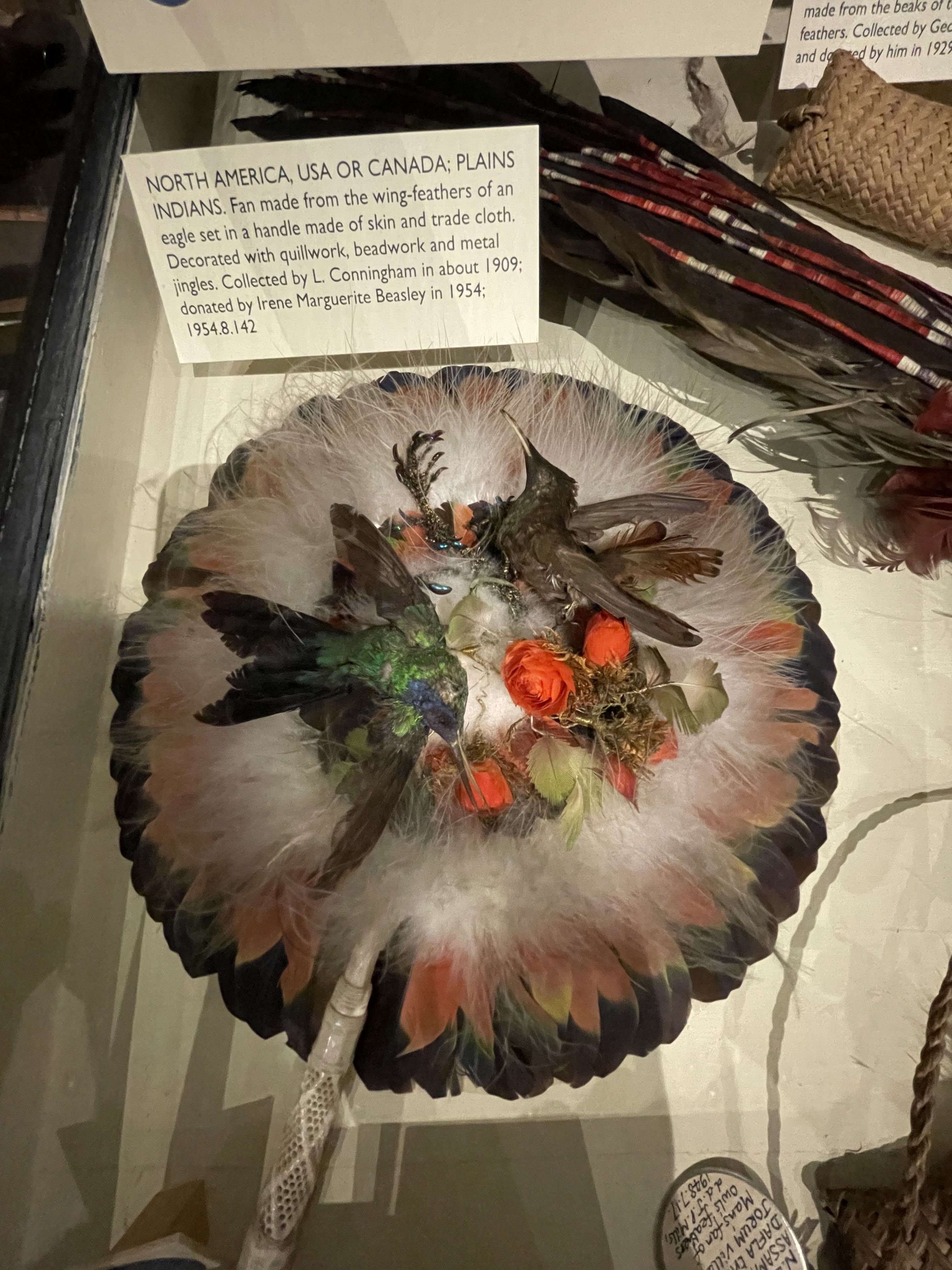
Feather fan
Feather fan

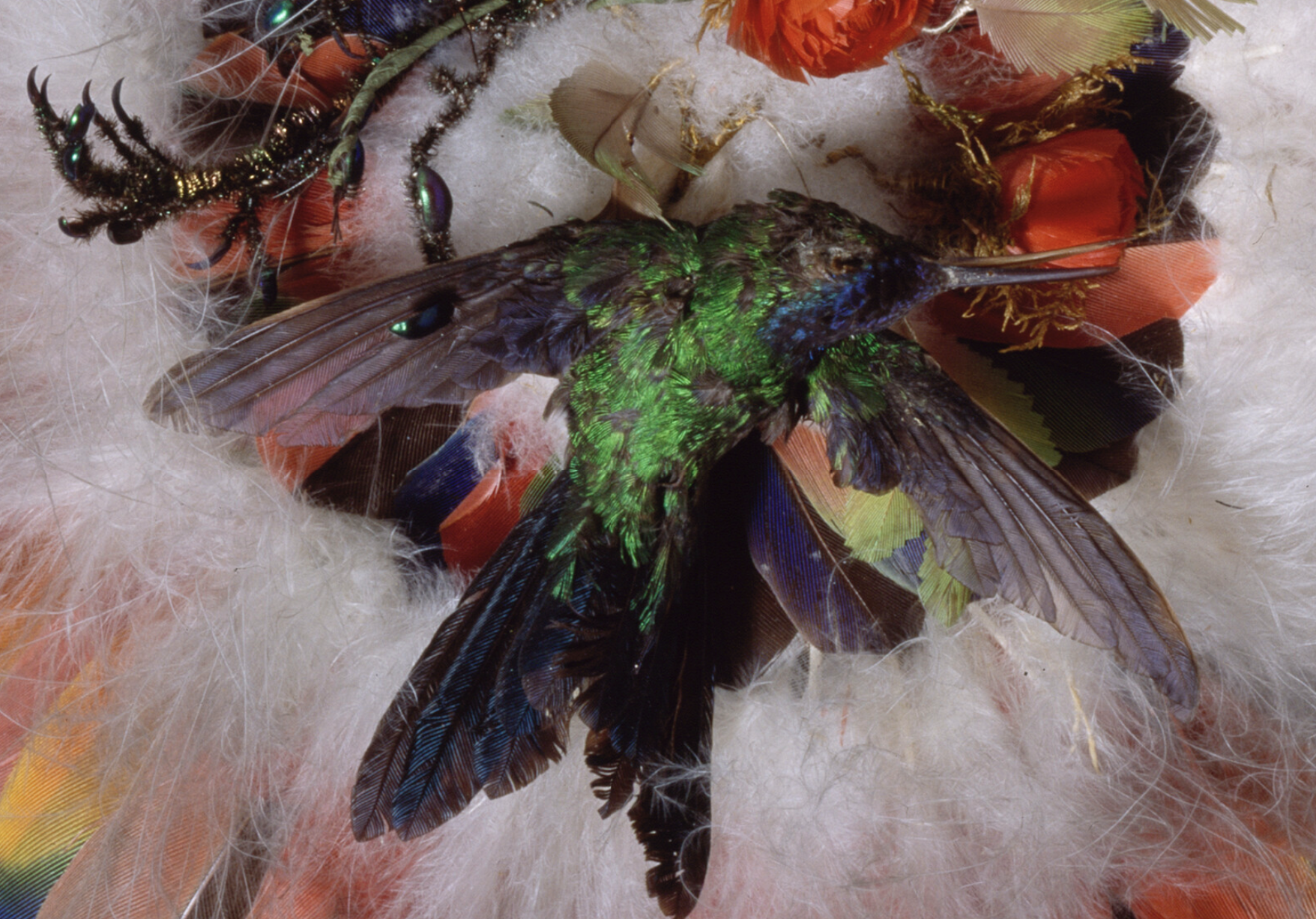

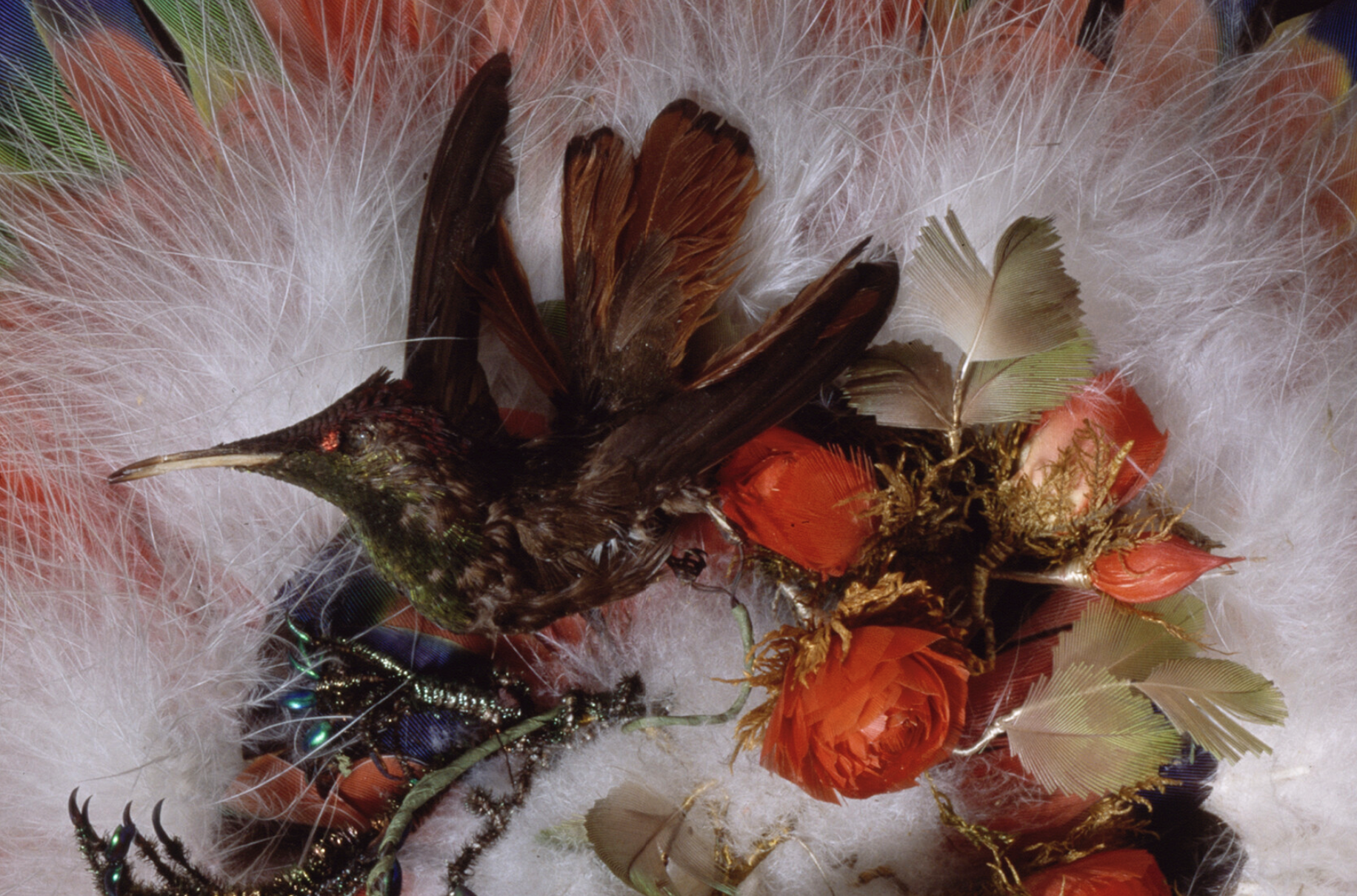
Hummingbird Fan
Trochilidae sp. / Amazona amazonica /Ara sp.
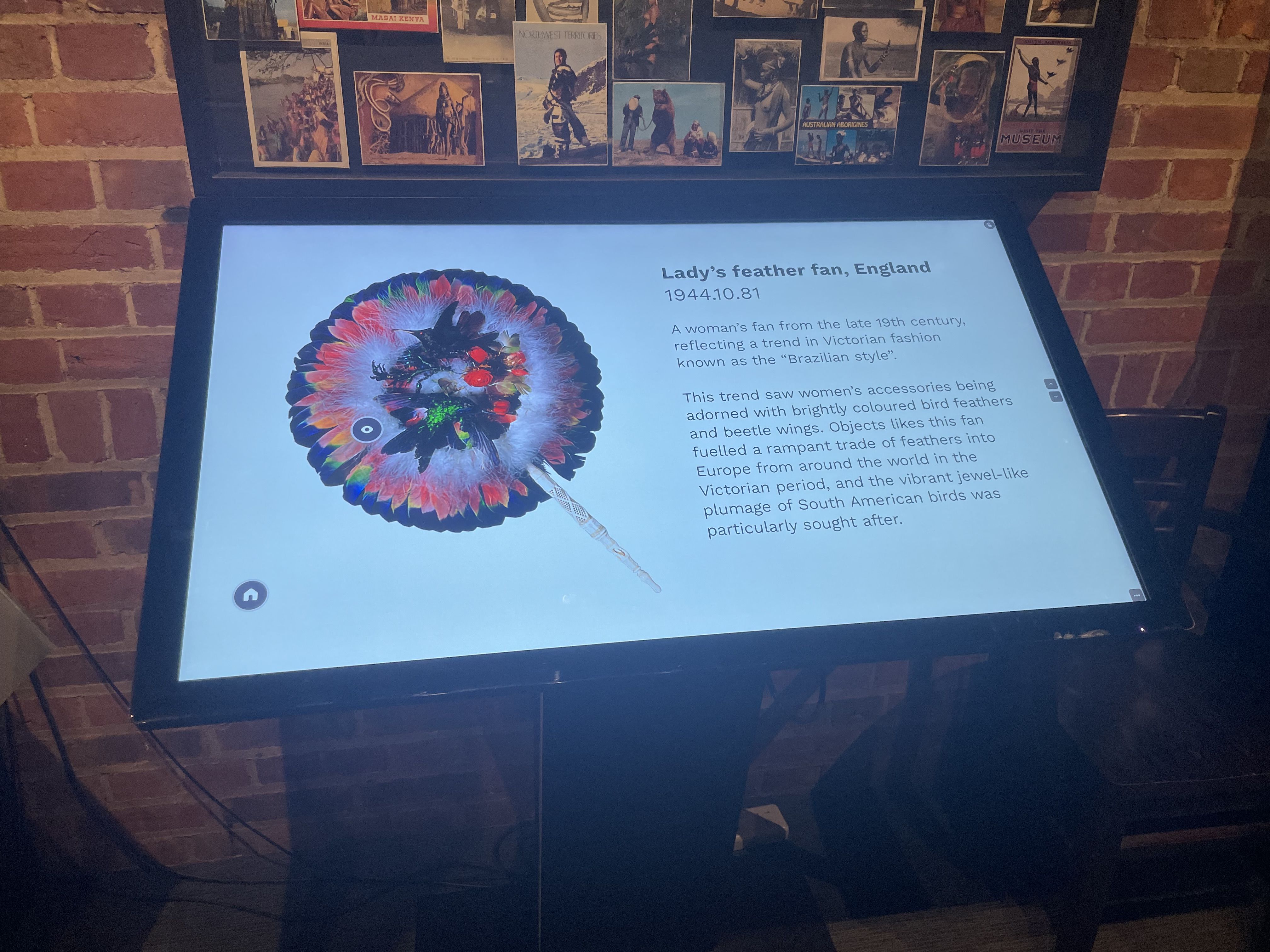
This intricate feather fan was likely made sometime around the mid-19th century. It follows a trend in Victorian fashion for accessorising with brightly coloured feathers, beetles and stuffed birds, a trend known as the “Brazilian style”. Though described as English, the parts of this fan probably came from all around the world.
The tiny roses were probably made in artisanal manufacturing houses in Rio de Janeiro in Brazil, where the production of imitation flowers made with bird feathers in Brazil rose to international prominence in the first quarter of the 19th century. The carved ivory handle probably came from China, before being assembled as a fan in a fashion house somewhere in Paris or London.
The hummingbirds mounted at the centre of the fan were some of the most highly-desired birds. Their tiny size and brilliant colours made them especially alluring for European consumers. While other birds such as parrots could be shipped alive across the Atlantic, the size and high metabolisms of hummingbirds meant they did not survive the processes of capture and transport to Europe in the same way. This meant, the only way for most Europeans to encounter hummingbirds was as dead specimens or through illustrations.
One American artist, Martin Johnson Heade, travelled to Brazil in 1863 with the ambition to paint hummingbirds "in all their variety of life." He called the resulting series of illustrations The Gems of Brazil, a title that reveals a lot about how Europeans and Americans of the time imagined the New World. Places like Brazil were seen as lands of exotic, high-value resources full of natural riches to be taken and brought back for the benefit of America and Europe.
Heade’s illustrations focus on the bright colours of the birds, positioned ornately in tranquil poses next to similarly colourful orchids and foliage. Like the feather fan, the focus is on the passive beauty of the birds, and there is very little trace of the feisty or tenacious character of the birds which would have been present in life.

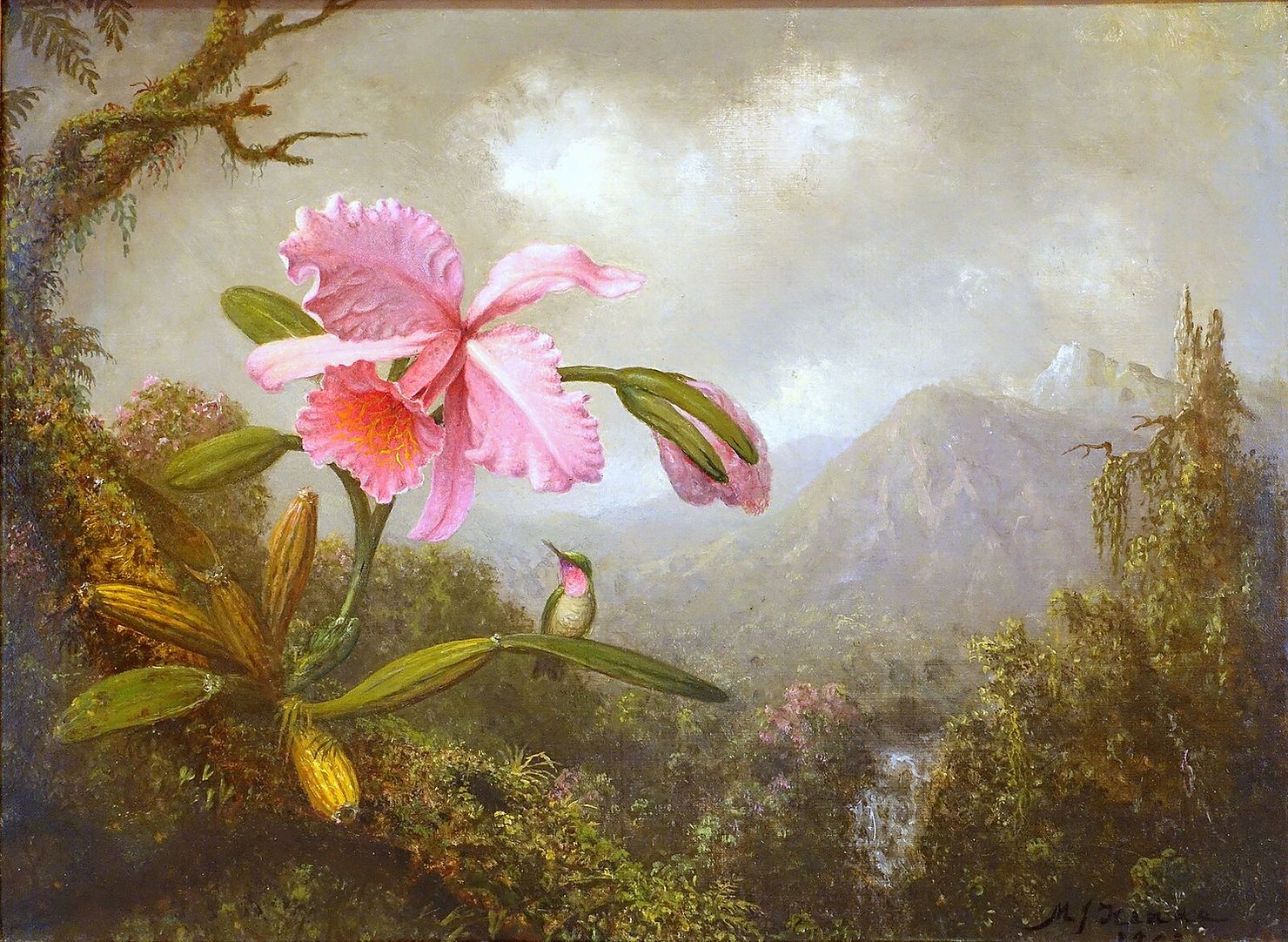
Demand for birds for the use in fashion items continued to increase throughout the 19th century, with the style reaching its peak in the 1880s. One London seller declared at the time that he had taken a delivery of over 40,000 hummingbirds in a single shipment!

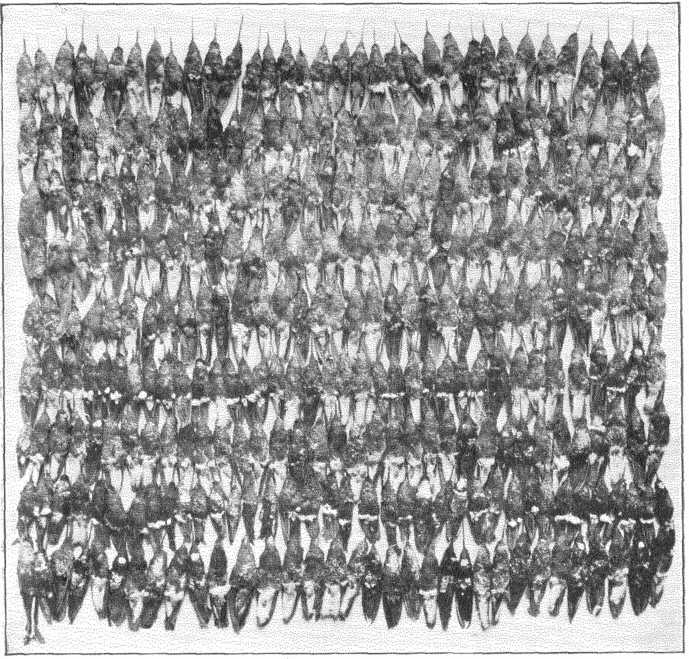
A lot of 1600 hummingbird skins in 1912. From William Hornaday (1913) Our Vanishing Wild Life.
A lot of 1600 hummingbird skins in 1912. From William Hornaday (1913) Our Vanishing Wild Life.
This seemingly ever-increasing demand for exotic birds led to concern for the conservation of bird populations in the wild. In 1889, largely in response to their frustration at the inaction of the male-only British Ornithology Union, Emily Williamson and Eliza Phillips initiated an all-women activist movement intended to put a stop to the fashion industry which was threatening to drive birds from all over the world to extinction. Their campaigning was eventually successful and in July 1921 the Plumage Prohibition Act was passed in Britain, banning the import of plumage. Their efforts also later resulted in the formation of the Royal Society for the Protection of Birds, or the RSPB, the largest bird conservation charity in the UK.


Emily Williamson, one of the founders of the RSPB.
Emily Williamson, one of the founders of the RSPB.


RSPB Logo
RSPB Logo
The tour concludes on the Lower Gallery. Look around the rest of the museum for other bird-objects - check out Hawaiian feather cloaks on the ground floor, or the sooty tern eggs from Rapa Nui on the other side of the mezzanine.

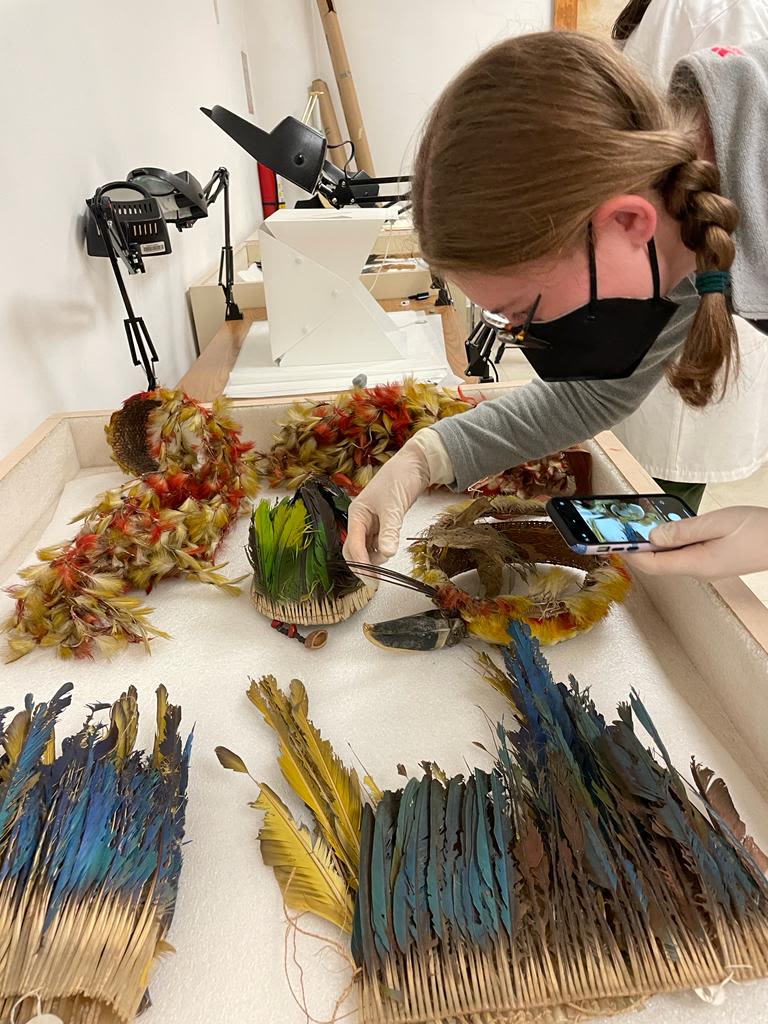
This tour was created as part of the research practice for Rosa's Collaborative Doctoral Project thesis. Funded by the Arts and Humanities Research Council
 Built with Shorthand